Having your offer accepted is an exciting moment, whether you're buying your first home or adding to your property portfolio. It's the point where everything starts to feel real and you can begin imagining yourself in your new home.
Whilst it's tempting to start planning the move, there's still an important legal process to complete before you can collect the keys. Don't worry if you're unsure what happens next, that's exactly what your conveyancer is there to guide you through.
The Short Answer
Once your offer has been accepted, your conveyancer will begin the legal process of investigating the property. This includes obtaining the contract papers from the seller's conveyancer, reviewing the legal title, carrying out searches, raising enquiries and, where applicable, working with your mortgage lender.
Only once all of the necessary legal work has been completed will you be ready to exchange contracts and agree a completion date.
The Explanation
After your offer has been accepted, one of the first things you'll need to do is formally instruct a conveyancer if you haven't already done so.
Your conveyancer will contact the seller's conveyancer and request the contract papers. These documents provide the legal information needed to begin investigating the property and will usually include the draft contract, title documents and the property information completed by the seller.
Whilst your conveyancer is reviewing these documents, they'll also arrange the necessary property searches and, if you're buying with a mortgage, review your mortgage offer once it has been received.
As the transaction progresses, your conveyancer may raise enquiries with the seller's conveyancer. These aren't problems, they're simply questions asked to clarify information or obtain documents needed before you commit to buying the property.
There will also be times when your conveyancer needs information from you. This may include proof of identity, evidence of your deposit, signed paperwork or responses to questions that arise during the transaction.
Once all of the legal investigations have been completed, any enquiries have been satisfactorily answered, your mortgage lender's requirements have been met and you're happy to proceed, you'll be ready to exchange contracts.
Who Might Be Involved in Your Conveyancing Transaction?
No two property transactions are exactly the same. Depending on the type of property you're buying and your individual circumstances, you may deal with some or all of the people and organisations below.
Who?
What do they do?
You
Provide instructions, complete paperwork, supply identification and proof of funds, and make the key decisions throughout the transaction.
Seller
Provides information about the property and signs the legal documentation needed to transfer ownership.
Estate Agent
Negotiates the sale, issues the Memorandum of Sale and helps keep communication flowing between everyone involved.
Your Conveyancer
Carries out the legal work, investigates the property, advises you on any issues and guides you through the transaction.
Seller's Conveyancer
Prepares the contract papers, responds to enquiries and deals with the legal aspects of the seller's transaction.
Mortgage Lender(if applicable)
Assesses your mortgage application and provides the funds for your purchase.
Surveyor(if instructed)
Inspects the property's condition and prepares a survey report.
Search Providers
Supply information about the property from organisations such as the Local Authority and water company.
Local Authority
Provides information relating to planning, highways and other matters through the Local Authority Search.
Provides information for leasehold properties and managed estates, including service charges, management arrangements and compliance requirements.
Freeholder(where applicable)
May need to provide information, certificates or consents for leasehold properties.
HM Land Registry
Registers you as the new legal owner once your purchase has completed.
Please note: Every transaction is different. A straightforward freehold purchase may involve fewer parties, whereas leasehold properties, new build homes or managed estates often require additional people or organisations to be involved.
Common Questions
How long will it take before I hear something?
Your conveyancer will usually begin work as soon as they're instructed. However, some stages depend on receiving information from third parties, such as the seller's conveyancer, your mortgage lender or search providers.
Can I book my removals now?
It's usually best to wait until contracts have been exchanged. Until then, neither party is legally committed to the transaction and the completion date has not been fixed.
Is there anything I need to do?
Yes. Your conveyancer may ask you to provide identification, evidence of your deposit, signed documents or other information during the transaction. Responding promptly can help avoid unnecessary delays.
Top Tip
If you haven't already done so, instruct your conveyancer as soon as your offer is accepted. The sooner the legal work can begin, the sooner your conveyancer can request the contract papers and start investigating the property.
Did You Know?
Several parts of the conveyancing process happen at the same time. Whilst your conveyancer is reviewing the legal title, property searches may be underway, your mortgage lender could be processing your application and your survey may also be taking place.
Common Misconception
"Once my offer has been accepted, the property is mine."
This is one of the most common misunderstandings.
Although your offer has been accepted, neither you nor the seller are legally bound to proceed until contracts have been exchanged. This is why it's important to allow your conveyancer to complete all of the necessary legal investigations before you commit to the purchase.
The MA Lawyers Approach
At MA Lawyers, we know that buying a property can feel like a waiting game, especially in the early stages when much of the work takes place behind the scenes.
As soon as we're instructed, we'll begin progressing your transaction by requesting the contract papers, carrying out the necessary legal investigations and keeping matters moving wherever possible. We'll also explain what we're doing, why we're doing it and let you know if we need anything from you.
Our aim is to ensure you're kept informed throughout the transaction, whilst carrying out the thorough legal investigations needed to protect your interests.
Related Articles
What is Conveyancing?
What does my conveyancer actually do?
Why do I have to prove where my money has come from?
What are property searches and why do I need them?
One of the first things your conveyancer is likely to do after receiving the contract papers is order property searches.
It's a question we're often asked:
"What exactly are property searches, and what are they looking for?"
Although they can sometimes feel like just another expense, property searches provide important information that simply can't be discovered by viewing the property. They help identify issues that could affect your decision to buy, your ability to obtain a mortgage or even the future value and enjoyment of your home.
The Short Answer
Property searches are enquiries made with various organisations to obtain information about the property you're buying and the surrounding area.
They help identify matters that may not be obvious during a viewing, such as planning issues, drainage arrangements, environmental risks or whether the roads serving the property are publicly maintained.
Your conveyancer will review the results carefully and explain anything you need to know before you commit to buying the property.
The Explanation
When you view a property, you see its appearance and condition.
Property searches help reveal everything you can't see.
They are obtained from organisations such as the Local Authority, water company and environmental data providers and are designed to identify matters that may affect the property now or in the future.
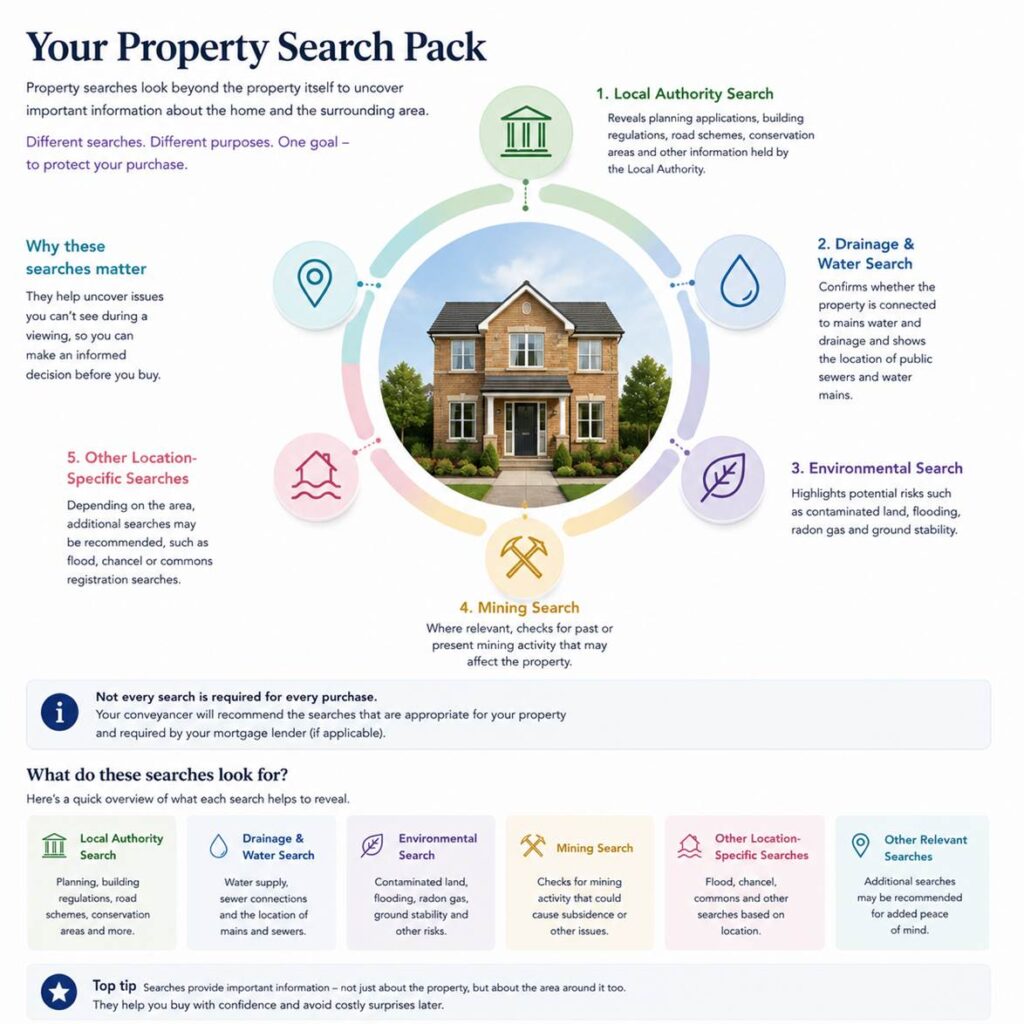
Not every search is required for every purchase. The searches your conveyancer recommends will depend on the property's location and, where applicable, your mortgage lender's requirements.
For example, a property in a former mining area may require a mining search, whilst properties in certain locations may benefit from additional searches relating to flooding or other environmental considerations.
If anything unexpected is revealed, your conveyancer will explain what it means, whether further investigations are required and how it may affect your purchase.
Your Property Search Pack
Please note: Every property is different. Your conveyancer will recommend the searches that are appropriate for your purchase and, where applicable, those required by your mortgage lender.
Common Questions
Can I buy a property without searches?
Sometimes, yes. Cash buyers can choose not to have searches carried out. However, this means important information about the property may remain unknown. Your conveyancer will explain the risks before you make that decision.
How long do searches take?
Search times vary depending on the organisation providing the information. Some are returned within a few days, whilst others, particularly Local Authority searches, can take longer.
What happens if a search reveals a problem?
Not every issue means you shouldn't buy the property. Your conveyancer will explain the result, advise you on any risks and, where necessary, raise further enquiries or recommend additional investigations.
Top Tip
Property searches aren't simply another cost, they're an investment in understanding exactly what you're buying before you become legally committed.
Did You Know?
Many issues revealed by property searches can't be discovered by viewing the property, speaking to the seller or even commissioning a survey.
Common Misconception
"The property looks fine, so the searches won't tell me anything new."
Some of the most important information about a property isn't visible. Searches can reveal matters such as future road schemes, planning restrictions, flood risks or public sewers running through the garden, things you simply wouldn't know from a viewing.
The MA Lawyers Approach
At MA Lawyers, we don't simply send you pages of search results and expect you to work them out for yourself.
We'll review every search carefully, explain any important findings in plain English and let you know if further investigations are required. If a search reveals something unexpected, we'll discuss your options with you so that you can make an informed decision before Exchange of Contracts.
You've found a property you love, your mortgage application is underway and your conveyancer has started the legal work.
Then someone asks:
"Have you arranged a survey?"
It's a common question, and understandably so. Many buyers assume that because they're getting a mortgage, the property is already being thoroughly checked. In reality, that's not always the case.
A survey and the legal work carried out by your conveyancer are two completely different things, and together they help you build a much clearer picture of the property you're buying.
The Short Answer
A survey looks at the condition of the property.
Your conveyancer looks at the legal title to the property.
They work alongside each other, but they investigate completely different things.
Whether you decide to have a survey is your choice, but many buyers feel it provides valuable reassurance before committing to such a significant purchase.
The Explanation
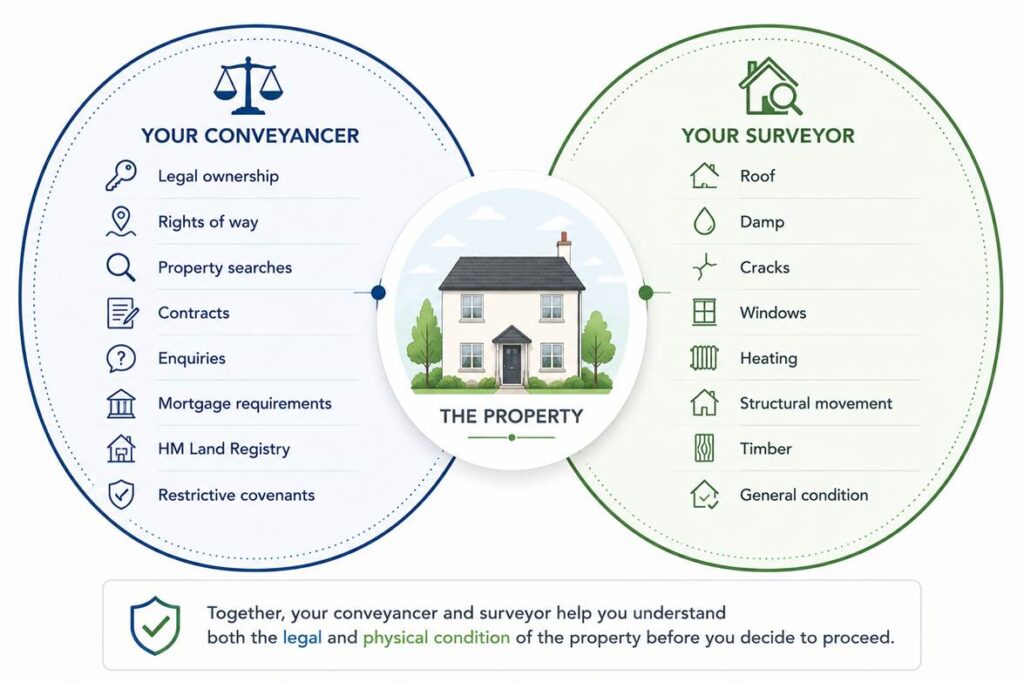
When you buy a property, there are two separate investigations taking place.
Your conveyancer investigates the legal aspects of the property. They'll review the title, searches, contracts and other legal documents to identify anything that may affect your ownership.
A survey, on the other hand, looks at the physical condition of the property. A qualified surveyor will inspect the building and report on matters such as structural movement, damp, roof condition, timber defects or other issues that may not be obvious during a viewing.
If you're buying with the assistance of a mortgage, your lender may arrange a mortgage valuation. However, this is carried out for the lender's benefit to assess whether the property provides adequate security for the loan. It isn't intended to be a detailed inspection of the property's condition.
If you're unsure which type of survey is right for your purchase, a surveyor will be able to explain the available options and recommend the most appropriate one.
Your Property Purchase - Two Different Investigations
Common Questions
Is a mortgage valuation the same as a survey?
No.
A mortgage valuation is carried out for your lender to assess whether the property offers sufficient security for the mortgage. It isn't a detailed inspection of the property's condition and shouldn't be relied upon as a survey.
Do I have to have a survey?
Not necessarily. Whether you choose to instruct a survey is entirely your decision. However, many buyers decide that a survey provides valuable information about the property's condition before they become legally committed.
Will my conveyancer tell me if the property has structural problems?
Your conveyancer investigates the legal aspects of the transaction. They aren't qualified to assess the physical condition of the property, which is why a survey can be an important part of the buying process.
Top Tip
Even if a property looks to be in excellent condition, some defects aren't immediately visible. A survey can provide valuable information that may help you make an informed decision before Exchange of Contracts.
Did You Know?
Your conveyancer and your surveyor are investigating completely different aspects of the property. One looks at the legal position, the other looks at the physical condition.
Common Misconception
"I'm getting a mortgage, so I don't need a survey."
A mortgage valuation is primarily for the lender's benefit. If you'd like a detailed assessment of the property's condition, you should consider instructing your own survey.
The MA Lawyers Approach
At MA Lawyers, we'll always explain the legal issues affecting your purchase in plain English. However, we also recognise the importance of understanding the property's physical condition.
Whilst we don't carry out surveys ourselves, we'll work alongside your surveyor where necessary and, if your survey identifies legal issues requiring further investigation, we'll discuss these with you and take any appropriate steps as part of your transaction.
Related Articles
What Are Property Searches and Why Do I Need Them?
Once the contract papers and property searches have been received, your conveyancer will usually raise pre-contract enquiries with the seller's conveyancer.
This often prompts the question:
"What exactly are you asking?"
The answer is that every property is different. Whilst some enquiries are raised on almost every purchase, many are specific to the individual property, the documents received or issues identified during the legal investigations.
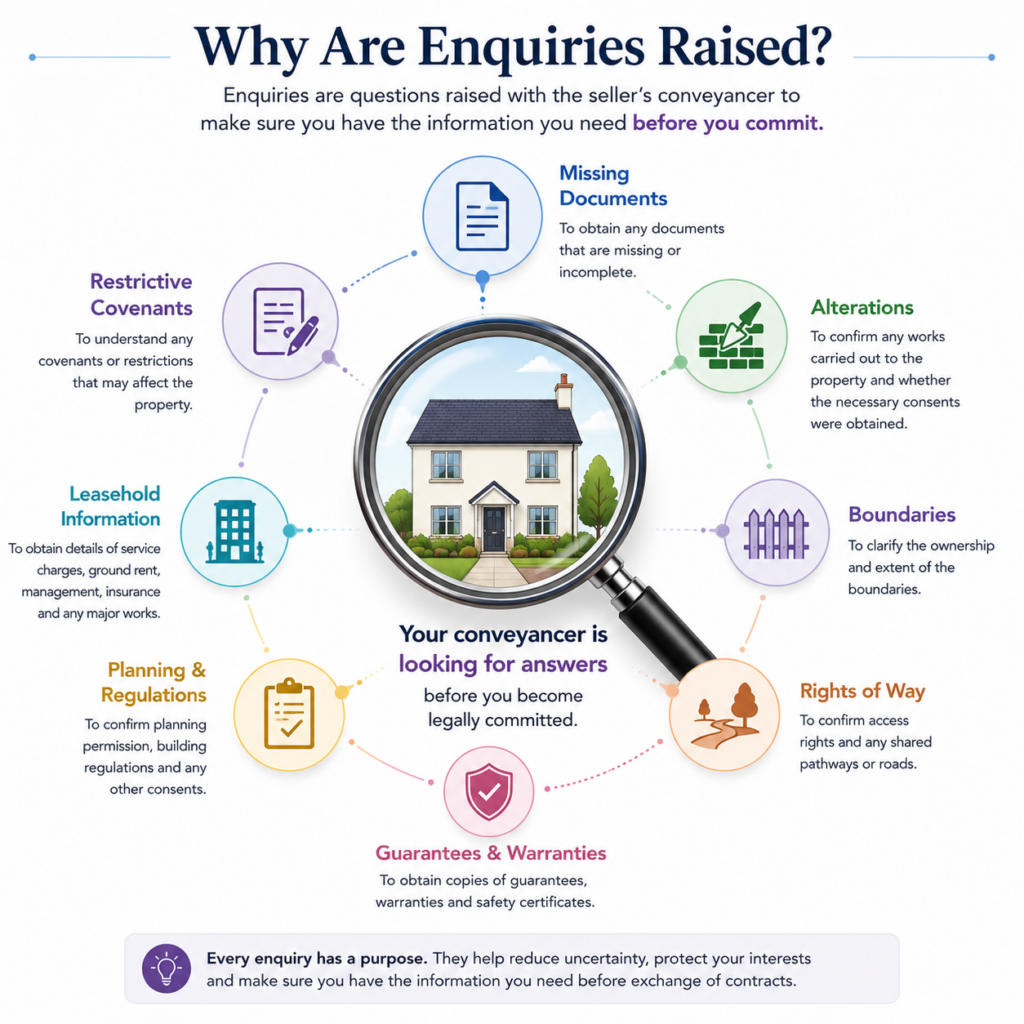
The purpose of enquiries isn't to delay your purchase—it's to make sure you have the information you need before deciding whether to proceed.
The Short Answer
Enquiries are questions raised with the seller's conveyancer to clarify information about the property or to request documents that are missing or incomplete.
Some enquiries are straightforward, whilst others may require the seller to obtain information from third parties, such as managing agents, freeholders or the Local Authority.
The number of enquiries raised isn't important. What matters is that your conveyancer has the information they need to properly advise you before Exchange of Contracts.
The Explanation
Your conveyancer will review the contract papers, title documents, property searches and the seller's completed property information forms.
If anything is unclear, inconsistent or requires further clarification, enquiries will be raised.
For example, your conveyancer may ask about:
Alterations or extensions carried out to the property.
Missing planning permission or Building Regulations approval.
Rights of way or shared access.
Boundaries.
Guarantees and warranties.
Restrictive covenants.
Service charges and ground rent (for leasehold properties).
Management company information.
Search results requiring clarification.
Occupiers, tenants or vacant possession.
Every enquiry has a purpose. Sometimes it's simply to obtain a missing document. Other times it's to ensure there isn't a legal issue that could affect your ownership or make the property difficult to sell in the future.
Common Questions
Can my conveyancer ask too many enquiries?
Your conveyancer will raise the enquiries they consider necessary based on the information available. Every enquiry should have a purpose and help clarify an aspect of the transaction.
Why is the seller taking so long to reply?
Some enquiries can be answered quickly, whilst others require the seller to obtain documents or information from third parties, such as managing agents, freeholders, Local Authorities or previous contractors.
What happens if an enquiry can't be answered?
Your conveyancer will explain the position, discuss any risks with you and advise you on the options available before you decide how to proceed.
Top Tip
Try not to judge progress by the number of enquiries raised. A transaction with ten enquiries isn't necessarily simpler than one with thirty. It's the quality of the replies, not the quantity of the questions, that matters.
Did You Know?
Some enquiries are raised because of something discovered in the property searches, whilst others arise from the title documents, the seller's forms or information revealed during the legal investigations.
Common Misconception
"Every conveyancer asks exactly the same enquiries."
Not necessarily.
Whilst there are common enquiries raised in many transactions, every conveyancer will tailor their enquiries to the property they're investigating and the issues they've identified.
That's why no two transactions are ever exactly the same.
The MA Lawyers Approach
At MA Lawyers, we don't believe in asking unnecessary questions simply for the sake of it.
Every enquiry we raise has a purpose. Our role is to investigate the property's legal position thoroughly and ensure you have the information you need before Exchange of Contracts.
Where replies require further clarification, we'll explain why additional enquiries are necessary and keep you informed throughout the process.
Related Articles
What Are Property Searches and Why Do I Need Them?
Buying a property is exciting, and once your offer has been accepted it's only natural to want everything to happen as quickly as possible.
One of the questions we're asked most often is:
"Why is my purchase taking so long?"
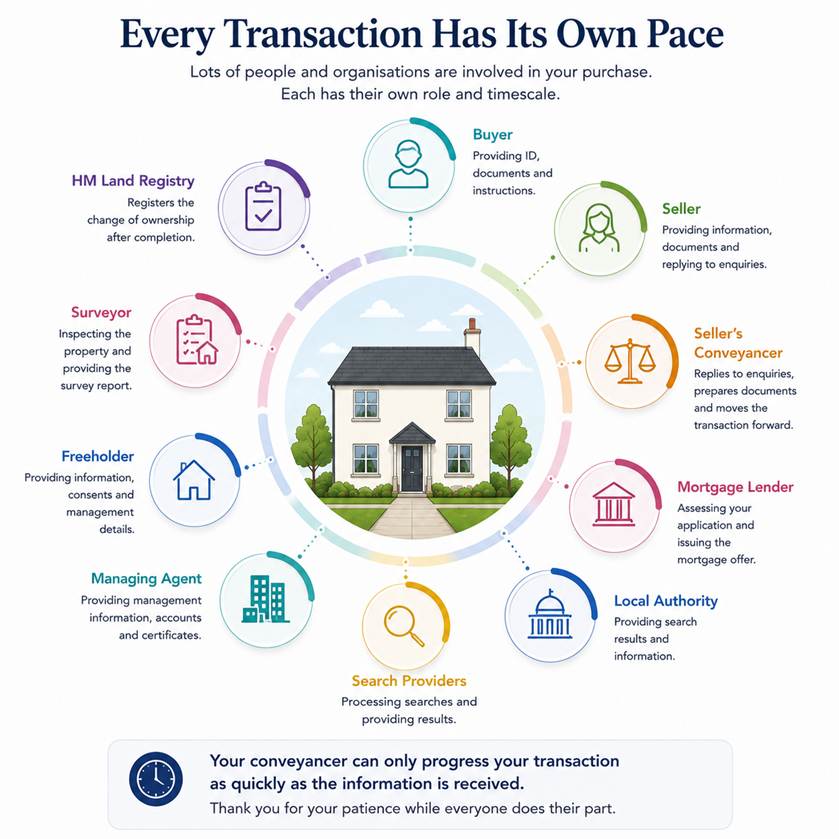
The simple answer is that a property transaction doesn't depend on just one person. It involves a number of different people and organisations, each carrying out their own part of the process before your purchase can move forward.
Whilst your conveyancer will continue progressing everything they can, there will often be stages where they're waiting for information from others before the next step can be taken.
The Short Answer
Every property transaction is different.
Some purchases progress quickly, whilst others take longer because they're waiting for information, documents or replies from one or more of the people involved.
A delay doesn't necessarily mean something has gone wrong. More often than not, it simply means one part of the process is still being completed.
The Explanation
Conveyancing isn't a single task—it's a series of legal investigations, checks and communications that often happen at the same time.
During your purchase, your conveyancer may be waiting for:
Property searches to be returned.
Replies to enquiries from the seller's conveyancer.
A mortgage offer from your lender.
Information from a managing agent or freeholder.
Survey results.
Documents from the seller.
Confirmation from the Local Authority or other organisations.
In many cases, several of these things are happening simultaneously.
Your conveyancer will continue progressing every aspect of your transaction that they can, but some stages simply cannot move forward until the necessary information has been received.
That's why two transactions, even on the same street, can progress at very different speeds.
Common Questions
Has something gone wrong if I haven't heard anything for a few days?
Not necessarily.
There are often periods where your conveyancer is waiting for information from third parties. During this time, they may also be reviewing documents, progressing other aspects of your transaction or preparing for the next stage.
If there's something you need to know or we need information from you, we'll be in touch.
Can my conveyancer speed things up?
Your conveyancer will do everything they reasonably can to progress your transaction, including chasing outstanding replies and keeping in contact with the other parties involved.
However, they can't control how quickly third parties respond.
What causes the biggest delays?
Every transaction is different, but common causes include:
Waiting for search results.
Delays in receiving mortgage offers.
Outstanding enquiries.
Leasehold management information.
Property chains.
Missing documents.
Waiting for all parties to be ready to exchange.
Top Tip
One of the best ways you can help keep your purchase moving is by responding promptly whenever your conveyancer asks you for information or documents.
Did You Know?
A straightforward purchase may involve communication with your mortgage lender, the seller's conveyancer, estate agents, search providers, surveyors, managing agents, freeholders, HM Land Registry and several other organisations—all before you receive the keys.
Common Misconception
"My conveyancer is doing nothing because I haven't had an update."
Much of the work involved in conveyancing happens behind the scenes.
Your conveyancer may be reviewing legal documents, raising enquiries, checking replies, speaking with third parties or preparing reports whilst waiting for information that allows the next stage of the transaction to progress.
The MA Lawyers Approach
At MA Lawyers, we appreciate that waiting can sometimes be the most frustrating part of buying a property.
Our approach is to keep your transaction progressing wherever possible, communicate with the people and organisations involved, and explain matters in plain English.
Whilst we can't control how quickly third parties respond, we can ensure that your file continues to move forward whenever the opportunity arises. If there's a significant development, or we need something from you, we'll let you know.
We use cookies to improve your experience, understand website usage, and support marketing. You can accept all cookies, reject optional cookies, or manage your preferences.
California residents can opt out of the sale or sharing of personal information by rejecting marketing cookies.