
Conveyancing Explained

Buying a property is likely to involve transferring some of the largest sums of money you’ve ever sent.
It’s completely understandable to feel nervous.
Unfortunately, property transactions are a target for fraudsters who attempt to trick buyers into sending money to fraudulent bank accounts by sending convincing emails or pretending to be a law firm.
At MA Lawyers, protecting your money is one of our highest priorities. We have procedures in place to help keep your funds secure, and we’ll guide you through every stage of the payment process.
The Short Answer
Your money is safest when you follow the payment instructions provided by MA Lawyers and verify any request for funds if you are ever unsure.
We’ll tell you:
- when money is required;
- exactly how much to send;
- where it should be sent;
- and the safest way to make your payment.
Most importantly…
We will never email you to tell you that our bank details have changed.
The Explanation
Conveyancing fraud has become increasingly sophisticated.
Fraudsters sometimes monitor property transactions and send emails that appear to come from your solicitor. These emails often ask you to transfer your deposit or completion monies to a different bank account.
These emails can look genuine.
That’s why we ask every client to remain vigilant throughout their transaction.
As part of your Client Care Pack, you’ll receive our Important Notice – Fraud Alert: Protecting Your Funds, which explains the warning signs, how our payment process works and what you should do if you ever receive a suspicious email.
How MA Lawyers Helps Protect You
| What We Do | Why It Matters | ||
| We provide our bank details securely at the beginning of your transaction. | You know exactly where your money should be sent. | ||
| We will never notify you of a change to our bank details by email. | This helps protect you from payment fraud. | ||
| We only request funds at the appropriate stage of your transaction. | You’ll know when a payment request is genuine. | ||
| We’ll provide clear written instructions before asking you to transfer money. | You’ll understand exactly what you’re paying and why. | ||
| If you’re unsure, we’re only a telephone call away. | We’d always rather you call us than risk sending money to the wrong account. | ||
These are all procedures we follow as part of our normal conveyancing process.

Common Questions
What if I receive an email saying your bank details have changed?
Treat it as suspicious.
Do not transfer any money.
Telephone us immediately using the contact details you already have so we can confirm the correct information.
How will I know when to send money?
We’ll only ask you to transfer money when the time is right.
Before requesting funds, we’ll explain what the payment is for and provide clear written instructions.
Should I check your bank details before making a payment?
Yes.
Even if you’ve received our payment instructions previously, if anything doesn’t look right or you’re uncertain for any reason, telephone us before sending any money.
We would much rather answer a quick phone call than have you worry.
Can fraudsters make emails look genuine?
Unfortunately, yes.
Some fraudulent emails closely resemble genuine correspondence and can arrive at key stages of your transaction.
That’s why it’s always safer to verify anything unexpected by telephone.
Top Tip
If in doubt, don’t transfer the money. Pick up the phone instead.
A two-minute telephone call could prevent a significant financial loss.
Did You Know?
Every MA Lawyers client receives our Fraud Alert – Protecting Your Funds notice as part of their Client Care documentation. It explains the risks of payment fraud, highlights the warning signs to look out for and asks clients to read and acknowledge the guidance before proceeding.
Common Misconception
“If an email looks genuine, it must be genuine.”
Not always.
Fraudsters are becoming increasingly sophisticated, and some fraudulent emails are designed to closely resemble genuine correspondence.
That’s why it’s important never to rely solely on an email when transferring large sums of money.
The MA Lawyers Approach
Protecting our clients’ money is just as important as protecting their legal interests.
We have clear procedures for requesting funds, we never change our bank details by email, and we encourage every client to contact us if they have any concerns before making a payment.
Your security is never an inconvenience to us—it’s an essential part of the service we provide.
Related Articles
- When Should I Transfer My Money?
- What Is Source of Funds?
- What Is a Gifted Deposit?
- What Is a Mortgage Offer?
- Why Doesn’t MA Lawyers Calculate My Stamp Duty?
Congratulations!
Accepting an offer on your property is an exciting milestone, but it’s also the point where the legal work really begins.
Many sellers assume that once an offer has been accepted, the hard part is over. In reality, there’s still a lot to do before contracts can be exchanged and your sale can be completed.
The good news is that your conveyancer will guide you through each stage, explain what’s happening and let you know if they need anything from you along the way.
The Short Answer
Once you’ve accepted an offer, your conveyancer will begin preparing the legal paperwork needed for the sale.
This includes obtaining your title documents, preparing the draft contract, reviewing the information you provide about the property and sending the contract pack to the buyer’s conveyancer.
The buyer’s conveyancer will then begin their legal investigations before deciding what further enquiries they need to raise.
The Explanation
Once you’ve instructed your conveyancer, they’ll start preparing your sale.
This usually involves:
- Obtaining your title documents from HM Land Registry.
- Preparing the draft contract.
- Asking you to complete the Property Information Form and, where applicable, the Fittings and Contents Form and Leasehold Information Form.
- Reviewing the information you’ve provided.
- Obtaining any additional documents that may be needed.
- Sending the contract pack to the buyer’s conveyancer.
Once the buyer’s conveyancer receives the contract pack, they’ll begin reviewing the legal title and supporting documents before raising any enquiries.
Whilst this is happening, there may also be other things progressing behind the scenes, such as the buyer arranging their mortgage, searches and survey.
Your conveyancer will continue progressing your sale wherever possible and will contact you if anything further is needed.

Common Questions
Do I need a conveyancer before accepting an offer?
No.
However, once you’ve accepted an offer, instructing your conveyancer promptly allows the legal work to begin without unnecessary delay.
What forms will I need to complete?
Most sellers will be asked to complete forms about the property, including information about boundaries, disputes, guarantees, alterations and what fixtures and fittings are included in the sale.
If you’re selling a leasehold property, you’ll usually be asked to complete additional leasehold information.
Can anything be done before the buyer is ready?
Yes.
Preparing the contract pack and completing the property forms early can often help reduce delays later in the transaction.
Top Tip
Complete your property forms carefully and honestly.
If you’re unsure about any question, ask your conveyancer rather than guessing. Clear and accurate information at the start can help avoid unnecessary enquiries later.
Did You Know?
The buyer’s conveyancer can’t begin their legal investigations until they’ve received the contract pack from the seller’s conveyancer.
Preparing it promptly is one of the first opportunities to help keep your transaction moving.
Common Misconception
“I’ve accepted an offer, so everything is agreed.”
Accepting an offer is an important milestone, but there are still legal investigations, enquiries and contracts to deal with before either party becomes legally committed.
The MA Lawyers Approach
At MA Lawyers, we like to get your sale moving as quickly as possible.
As soon as we’re instructed, we’ll begin preparing your contract pack, review the information you’ve provided and issue the legal papers to the buyer’s conveyancer without unnecessary delay.
Starting the legal work early often helps prevent avoidable delays later in the transaction and gives your buyer the information they need to begin their legal investigations.
Related Articles
- What Does My Conveyancer Actually Do?
- What Information Will I Need to Provide?
- What Enquiries Will the Buyer Raise?
- Why Is My Sale Taking So Long?
Firstly, congratulations!
Having your offer accepted is an exciting moment, whether you’re buying your first home or adding to your property portfolio. It’s the point where everything starts to feel real and you can begin imagining yourself in your new home.
Whilst it’s tempting to start planning the move, there’s still an important legal process to complete before you can collect the keys. Don’t worry if you’re unsure what happens next, that’s exactly what your conveyancer is there to guide you through.
The Short Answer
Once your offer has been accepted, your conveyancer will begin the legal process of investigating the property. This includes obtaining the contract papers from the seller’s conveyancer, reviewing the legal title, carrying out searches, raising enquiries and, where applicable, working with your mortgage lender.
Only once all of the necessary legal work has been completed will you be ready to exchange contracts and agree a completion date.
The Explanation
After your offer has been accepted, one of the first things you’ll need to do is formally instruct a conveyancer if you haven’t already done so.
Your conveyancer will contact the seller’s conveyancer and request the contract papers. These documents provide the legal information needed to begin investigating the property and will usually include the draft contract, title documents and the property information completed by the seller.
Whilst your conveyancer is reviewing these documents, they’ll also arrange the necessary property searches and, if you’re buying with a mortgage, review your mortgage offer once it has been received.
As the transaction progresses, your conveyancer may raise enquiries with the seller’s conveyancer. These aren’t problems, they’re simply questions asked to clarify information or obtain documents needed before you commit to buying the property.
There will also be times when your conveyancer needs information from you. This may include proof of identity, evidence of your deposit, signed paperwork or responses to questions that arise during the transaction.
Once all of the legal investigations have been completed, any enquiries have been satisfactorily answered, your mortgage lender’s requirements have been met and you’re happy to proceed, you’ll be ready to exchange contracts.
Who Might Be Involved in Your Conveyancing Transaction?
No two property transactions are exactly the same. Depending on the type of property you’re buying and your individual circumstances, you may deal with some or all of the people and organisations below.
| Who? | What do they do? |
| You | Provide instructions, complete paperwork, supply identification and proof of funds, and make the key decisions throughout the transaction. |
| Seller | Provides information about the property and signs the legal documentation needed to transfer ownership. |
| Estate Agent | Negotiates the sale, issues the Memorandum of Sale and helps keep communication flowing between everyone involved. |
| Your Conveyancer | Carries out the legal work, investigates the property, advises you on any issues and guides you through the transaction. |
| Seller’s Conveyancer | Prepares the contract papers, responds to enquiries and deals with the legal aspects of the seller’s transaction. |
| Mortgage Lender (if applicable) | Assesses your mortgage application and provides the funds for your purchase. |
| Surveyor (if instructed) | Inspects the property’s condition and prepares a survey report. |
| Search Providers | Supply information about the property from organisations such as the Local Authority and water company. |
| Local Authority | Provides information relating to planning, highways and other matters through the Local Authority Search. |
| Managing Agent / Management Company (where applicable) | Provides information for leasehold properties and managed estates, including service charges, management arrangements and compliance requirements. |
| Freeholder (where applicable) | May need to provide information, certificates or consents for leasehold properties. |
| HM Land Registry | Registers you as the new legal owner once your purchase has completed. |
Please note: Every transaction is different. A straightforward freehold purchase may involve fewer parties, whereas leasehold properties, new build homes or managed estates often require additional people or organisations to be involved.
Common Questions
How long will it take before I hear something?
Your conveyancer will usually begin work as soon as they’re instructed. However, some stages depend on receiving information from third parties, such as the seller’s conveyancer, your mortgage lender or search providers.
Can I book my removals now?
It’s usually best to wait until contracts have been exchanged. Until then, neither party is legally committed to the transaction and the completion date has not been fixed.
Is there anything I need to do?
Yes. Your conveyancer may ask you to provide identification, evidence of your deposit, signed documents or other information during the transaction. Responding promptly can help avoid unnecessary delays.
Top Tip
If you haven’t already done so, instruct your conveyancer as soon as your offer is accepted. The sooner the legal work can begin, the sooner your conveyancer can request the contract papers and start investigating the property.
Did You Know?
Several parts of the conveyancing process happen at the same time. Whilst your conveyancer is reviewing the legal title, property searches may be underway, your mortgage lender could be processing your application and your survey may also be taking place.
Common Misconception
“Once my offer has been accepted, the property is mine.”
This is one of the most common misunderstandings.
Although your offer has been accepted, neither you nor the seller are legally bound to proceed until contracts have been exchanged. This is why it’s important to allow your conveyancer to complete all of the necessary legal investigations before you commit to the purchase.
The MA Lawyers Approach
At MA Lawyers, we know that buying a property can feel like a waiting game, especially in the early stages when much of the work takes place behind the scenes.
As soon as we’re instructed, we’ll begin progressing your transaction by requesting the contract papers, carrying out the necessary legal investigations and keeping matters moving wherever possible. We’ll also explain what we’re doing, why we’re doing it and let you know if we need anything from you.
Our aim is to ensure you’re kept informed throughout the transaction, whilst carrying out the thorough legal investigations needed to protect your interests.
Related Articles
- What is Conveyancing?
- What does my conveyancer actually do?
- Why do I have to prove where my money has come from?
- What are property searches and why do I need them?
- What is Exchange of Contracts?
Many sellers are surprised when they hear that the buyer’s conveyancer has raised enquiries.
It’s common to wonder:
“Haven’t I already completed all the forms?”
or
“Why are they asking so many questions?”
The truth is that enquiries are a normal part of almost every property transaction. They help the buyer understand the property, clarify anything that isn’t clear from the paperwork and ensure they have the information they need before deciding whether to proceed.
Most enquiries are entirely routine and don’t mean there’s a problem with your sale.
The Short Answer
The buyer’s conveyancer will review the title documents, the property forms, the contract papers, search results and any supporting documents before raising any enquiries.
Some enquiries are standard and arise on almost every transaction, whilst others are specific to your property.
Your conveyancer will review the enquiries, explain anything that requires your input and prepare the replies on your behalf.
The Explanation
Once the buyer’s conveyancer has received the contract pack, they’ll begin investigating the legal title to your property.
They’ll compare the information you’ve provided with the legal documents and look for anything that needs clarification.
For example, they may ask about:
- Alterations or extensions to the property.
- Planning permission or Building Regulations approval.
- Guarantees and warranties.
- Rights of way or shared access.
- Boundaries.
- Disputes or complaints.
- Fixtures and fittings.
- Service charges and ground rent (for leasehold properties).
- Management company information.
- Occupiers at the property.
- Mortgage redemption arrangements.
- Missing paperwork or certificates.
Not every seller will receive the same enquiries.
Some properties generate very few questions, whilst older properties, leasehold homes or properties that have been altered may naturally require further clarification.
The important thing to remember is that enquiries are simply part of the legal process. They allow the buyer’s conveyancer to report fully to their client before contracts are exchanged.

Common Questions
Have the enquiries been raised because there’s a problem?
Usually not.
Most enquiries are routine and arise because the buyer’s conveyancer is carrying out their legal investigations thoroughly.
Do I have to answer every enquiry myself?
Not necessarily.
Many enquiries are answered by your conveyancer using the legal documents already available. Where your knowledge is needed, we’ll explain exactly what information we’re asking you to provide.
What if I don’t know the answer?
That’s perfectly acceptable.
If you’re unsure, let us know. It’s always better to say you don’t know than to guess.
We’ll discuss whether the information can be obtained from another source or whether a different response is appropriate.
Why are they asking about something that happened years ago?
The buyer’s conveyancer is trying to establish the legal position of the property, not just what’s happened recently.
Sometimes historic alterations, guarantees or legal documents remain relevant even if the work was carried out many years ago.
Top Tip
If you have certificates, guarantees, planning permissions or Building Regulations approvals, keep them together from the outset.
Having them ready often allows enquiries to be answered much more quickly.
Did You Know?
Many enquiries can be answered before they’re even raised if the seller provides clear, complete information and supporting documents at the beginning of the transaction.
Common Misconception
“The buyer’s conveyancer is trying to make the sale fall through.”
Almost never.
Their job is to protect their client’s interests by ensuring they have all the information they need before becoming legally committed to buying the property.
The MA Lawyers Approach
At MA Lawyers, we review every enquiry carefully before sending it to you.
Many enquiries can be answered using the legal paperwork we already hold, meaning you won’t be asked to deal with matters unnecessarily.
Where we do need your help, we’ll explain what the enquiry means, why it’s being asked and exactly what information we’re looking for.
Our aim is to provide clear, accurate replies that help keep your sale progressing while ensuring the buyer has the information they need to make an informed decision.
Related Articles
- Why Do I Have to Complete So Many Forms?
- What If I’ve Lost Paperwork?
- Why Is My Sale Taking So Long?
- When Will I Receive My Sale Proceeds?
Whether you’re buying your very first home or you’ve moved several times before, you’ve probably heard the word conveyancing.
But what does it actually mean?
Many people imagine piles of paperwork, complicated legal language and endless waiting.
The reality is quite different.
Conveyancing is the legal process of transferring ownership of a property from one person to another, but it’s also about making sure you’re buying or selling safely.
Behind every successful property transaction is a conveyancer working to uncover potential problems before they become your problems.
Our job isn’t simply to help you move house—it’s to help you move with confidence.
The Short Answer
Conveyancing is the legal process of transferring ownership of a property from the seller to the buyer.
It begins when your offer has been accepted and continues until you’re registered as the legal owner at HM Land Registry.
During that time, your conveyancer carries out legal investigations, checks important documents, works with your mortgage lender (where applicable), liaises with the other parties involved and ensures everything is in place for a safe and successful completion.
The Explanation
Buying a property may look simple from the outside.
You find a home you love, agree a price and collect the keys.
In reality, there’s a great deal happening behind the scenes before ownership can legally change hands.
Your conveyancer is responsible for investigating the property from a legal perspective.
That means checking that the seller has the legal right to sell it, reviewing the title, identifying rights, restrictions and obligations, carrying out property searches, raising enquiries and ensuring there are no issues that could affect your ownership in the future.
If you’re buying with a mortgage, your conveyancer also acts for your lender, ensuring the property provides suitable security for the loan and that the lender’s legal requirements have been met.
Throughout the transaction, your conveyancer works with estate agents, mortgage lenders, the seller’s conveyancer, search providers, HM Land Registry and, in some cases, managing agents, freeholders and local authorities.
It’s often described as a legal process, but in reality it’s a process of gathering information, solving problems and protecting your interests.
Sometimes everything progresses quickly.
Sometimes additional investigations are needed.
There may even be periods where it seems little is happening, but that’s often because your conveyancer is waiting for information from third parties or carefully reviewing documents before the transaction can safely move forward.
Conveyancing isn’t about completing paperwork for the sake of it.
It’s about making sure that when you finally receive the keys to your new home, you know exactly what you’re buying and there are no unexpected legal surprises waiting for you.

Common Questions
Is conveyancing only needed when buying a property?
No.
Conveyancing is required whenever legal ownership of a property changes. This includes buying, selling, remortgaging, transfers of equity, some leasehold matters and several specialist property transactions.
Why does conveyancing seem to take so long?
Although there are only a few key stages, each one relies on information being provided by a number of different people and organisations.
Your conveyancer is often waiting for search results, mortgage instructions, replies to enquiries or documents from third parties before the transaction can safely progress.
Can I do conveyancing myself?
In some circumstances, it’s legally possible.
However, most buyers choose to instruct a conveyancer because of the legal complexity involved and because mortgage lenders will usually require a conveyancer to act on their behalf.
When does the property legally become mine?
Not when your offer is accepted.
Not when contracts are signed.
Ownership legally changes on Completion Day, when the purchase money is transferred and completion takes place.
Top Tip
Instruct your conveyancer as early as possible.
Having your conveyancer ready to act means the legal process can begin as soon as your offer is accepted, helping to avoid unnecessary delays at the very start of your transaction.
Did You Know?
The word “conveyancing” comes from the legal term “to convey”, which simply means to transfer ownership of property from one person to another.
Common Misconception
“Conveyancing is just paperwork.”
Not at all.
Most of a conveyancer’s work involves investigating legal issues, identifying risks, asking questions, solving problems and protecting your interests long before completion takes place.
The paperwork simply records the outcome of all that work.
The MA Lawyers Approach
At MA Lawyers, we believe conveyancing is about far more than forms and legal documents.
It’s about giving our clients the confidence to make one of life’s biggest financial decisions, knowing that someone is looking after their legal interests every step of the way.
We’ll explain the process in plain English, keep you informed as your transaction progresses and carry out the detailed legal work needed to help protect both you and your investment.
Whether you’re buying your first home or your fifteenth, our aim is always the same—to make the legal process as straightforward, transparent and reassuring as possible.
Related Articles
- I’ve Had My Offer Accepted – What Happens Next?
- What Does My Conveyancer Actually Do?
- What Are Property Searches and Why Do I Need Them?
- Who Is Involved at Each Stage?
- Why Do Transactions Take So Long?
One of the first things your conveyancer is likely to do after receiving the contract papers is order property searches.
It’s a question we’re often asked:
“What exactly are property searches, and what are they looking for?”
Although they can sometimes feel like just another expense, property searches provide important information that simply can’t be discovered by viewing the property. They help identify issues that could affect your decision to buy, your ability to obtain a mortgage or even the future value and enjoyment of your home.
The Short Answer
Property searches are enquiries made with various organisations to obtain information about the property you’re buying and the surrounding area.
They help identify matters that may not be obvious during a viewing, such as planning issues, drainage arrangements, environmental risks or whether the roads serving the property are publicly maintained.
Your conveyancer will review the results carefully and explain anything you need to know before you commit to buying the property.
The Explanation
When you view a property, you see its appearance and condition.
Property searches help reveal everything you can’t see.
They are obtained from organisations such as the Local Authority, water company and environmental data providers and are designed to identify matters that may affect the property now or in the future.
Not every search is required for every purchase. The searches your conveyancer recommends will depend on the property’s location and, where applicable, your mortgage lender’s requirements.
For example, a property in a former mining area may require a mining search, whilst properties in certain locations may benefit from additional searches relating to flooding or other environmental considerations.
If anything unexpected is revealed, your conveyancer will explain what it means, whether further investigations are required and how it may affect your purchase.
Your Property Search Pack
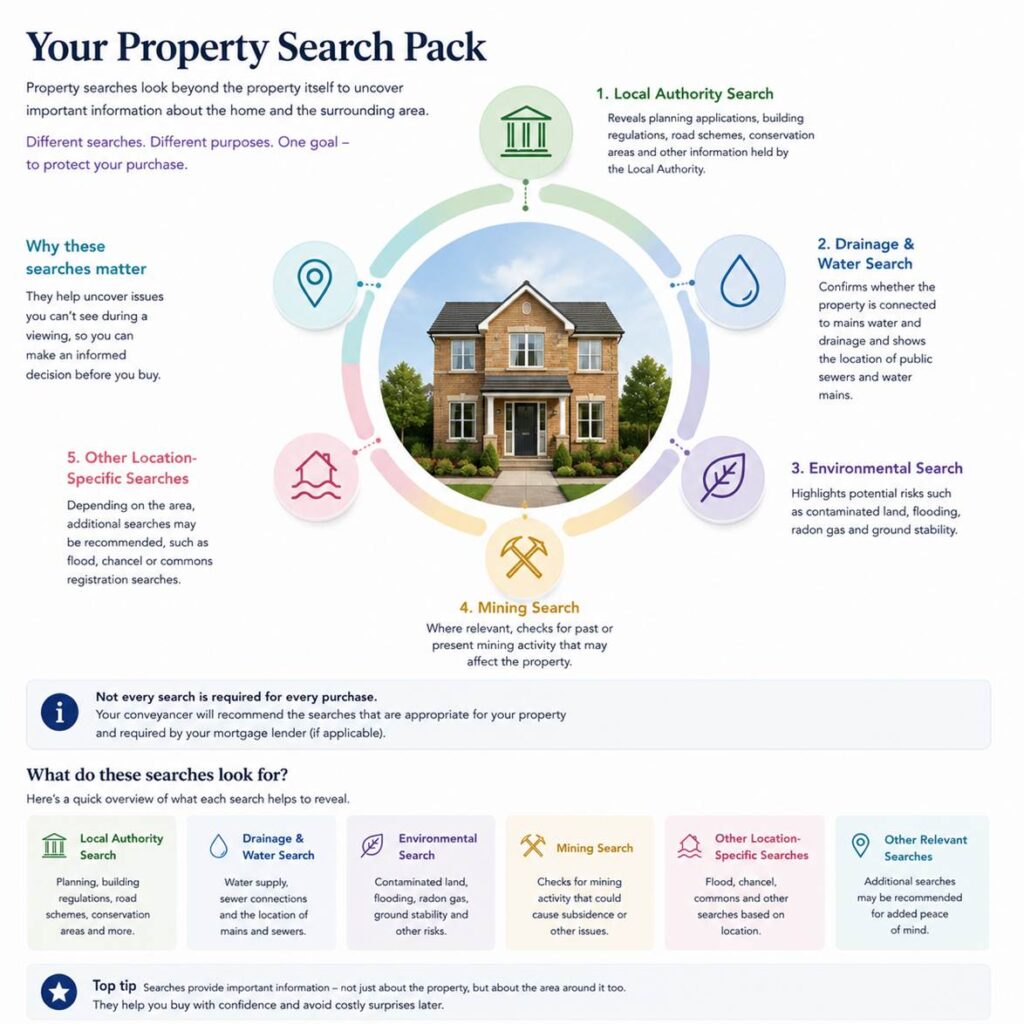
Please note: Every property is different. Your conveyancer will recommend the searches that are appropriate for your purchase and, where applicable, those required by your mortgage lender.
Common Questions
Can I buy a property without searches?
Sometimes, yes. Cash buyers can choose not to have searches carried out. However, this means important information about the property may remain unknown. Your conveyancer will explain the risks before you make that decision.
How long do searches take?
Search times vary depending on the organisation providing the information. Some are returned within a few days, whilst others, particularly Local Authority searches, can take longer.
What happens if a search reveals a problem?
Not every issue means you shouldn’t buy the property. Your conveyancer will explain the result, advise you on any risks and, where necessary, raise further enquiries or recommend additional investigations.
Top Tip
Property searches aren’t simply another cost, they’re an investment in understanding exactly what you’re buying before you become legally committed.
Did You Know?
Many issues revealed by property searches can’t be discovered by viewing the property, speaking to the seller or even commissioning a survey.
Common Misconception
“The property looks fine, so the searches won’t tell me anything new.”
Some of the most important information about a property isn’t visible. Searches can reveal matters such as future road schemes, planning restrictions, flood risks or public sewers running through the garden, things you simply wouldn’t know from a viewing.
The MA Lawyers Approach
At MA Lawyers, we don’t simply send you pages of search results and expect you to work them out for yourself.
We’ll review every search carefully, explain any important findings in plain English and let you know if further investigations are required. If a search reveals something unexpected, we’ll discuss your options with you so that you can make an informed decision before Exchange of Contracts.
Related Articles
What Is Exchange of Contracts?
What Is a Survey and Do I Need One?
What Enquiries Will My Conveyancer Raise?
Why Do Transactions Take So Long?
If you’re buying with the help of a mortgage, you’ll hear the term Mortgage Offer throughout your conveyancing transaction.
Many buyers assume that once their mortgage application has been submitted, everything is approved and ready to go. In reality, there’s an important difference between applying for a mortgage, receiving an Agreement in Principle and receiving a formal Mortgage Offer.
Understanding what a Mortgage Offer is, and why your conveyancer needs it, will help you understand one of the most important milestones in your purchase.
The Short Answer
A Mortgage Offer is your lender’s formal confirmation that they have agreed to lend you the money to purchase your property.
It sets out:
- how much they are willing to lend;
- the conditions of the loan;
- any special requirements;
- and how long the offer remains valid.
Before we can exchange contracts, we must ensure that your Mortgage Offer has been received, reviewed and that any lender requirements have been satisfied.
The Explanation
Buying a property with a mortgage involves more than simply borrowing money.
Before issuing a Mortgage Offer, your lender will usually:
- assess your mortgage application;
- carry out affordability checks;
- arrange a valuation of the property;
- review your financial circumstances;
- confirm that the property is suitable security for the loan.
Once they are satisfied, they’ll issue a Mortgage Offer to both you and your conveyancer.
Your conveyancer must then review the offer carefully to ensure:
- your details are correct;
- the property details are correct;
- there are no special conditions that need to be satisfied before completion;
- the legal title meets your lender’s requirements.
Only once these checks have been completed can we prepare for Exchange of Contracts and request your mortgage funds for Completion.

Common Questions
Is an Agreement in Principle the same as a Mortgage Offer?
No.
An Agreement in Principle is an initial indication that you may be able to borrow a certain amount. It is not a commitment to lend.
A Mortgage Offer is the lender’s formal approval.
Can I exchange contracts before my Mortgage Offer arrives?
Usually not.
Before Exchange of Contracts, we need to ensure your mortgage arrangements are in place and that any lender conditions have been satisfied.
Does my Mortgage Offer expire?
Yes.
Most Mortgage Offers are valid for a fixed period.
If your purchase is delayed, we may need to ask your lender whether the offer can be extended or whether a new application is required.
Will you request the mortgage money?
Yes.
Once we’re ready for Completion, we’ll request your mortgage advance from your lender so the funds arrive in time for your Completion date.
Top Tip
Read your Mortgage Offer carefully when you receive it.
Although your conveyancer will also review it, it’s important that you understand the amount you’re borrowing, the repayment terms and any special conditions that apply.
Did You Know?
Your Mortgage Offer isn’t just sent to you.
Your lender also sends a copy to your conveyancer so that we can ensure all of the lender’s legal requirements are satisfied before Completion.
Common Misconception
“Once my mortgage application has been submitted, everything is approved.”
Not quite.
Your application still needs to be assessed before your lender decides whether to issue a formal Mortgage Offer.
The MA Lawyers Approach
At MA Lawyers, we carefully review every Mortgage Offer to ensure that both you and your lender are fully protected.
We’ll explain any conditions that require your attention, deal directly with your lender where necessary and make sure everything is in place before requesting your mortgage funds for Completion.
Related Articles
- When Should I Transfer My Money?
- What Is Source of Funds?
- What Is a Gifted Deposit?
- Why Are You Asking Me for So Much Information?
- Why Doesn’t MA Lawyers Calculate Stamp Duty?
When Should I Instruct My Conveyancer?
Congratulations, your offer has been accepted.
It’s an exciting milestone, but it’s also the point where many buyers ask the same question:
“Should I wait until my mortgage offer arrives, or should I instruct my conveyancer now?”
The simple answer is that, in most cases, you should instruct your conveyancer as soon as your offer has been accepted.
Whilst we can’t begin investigating the legal title until we receive the contract papers from the seller’s conveyancer, there’s a great deal we can do behind the scenes to prepare your transaction.
Starting early means we’re ready to begin legal work as soon as the paperwork arrives, helping to avoid unnecessary delays later in the process.
The Short Answer
Ideally, you should instruct your conveyancer as soon as your offer has been accepted.
The earlier we’re instructed, the sooner we can complete the important preparation work needed before the legal investigation begins.
Think of it as preparing for a journey.
You can’t leave until everyone is ready, but there’s no reason to wait before packing your bags.
The Explanation
Many people assume that conveyancing starts when contracts arrive from the seller’s solicitor.
In reality, a lot happens before then.
Once you’re ready to proceed, the estate agent will usually issue a Memorandum of Sale confirming the agreed price and the details of both parties’ conveyancers.
As soon as we’re instructed, we can begin preparing your file.
This usually includes:
- verifying your identity;
- completing our Anti-Money Laundering checks;
- discussing your deposit and Source of Funds;
- obtaining details of your mortgage lender (if applicable);
- sending you your client care documents;
- answering any questions you may have about the process.
Whilst we’re completing these steps, your mortgage lender can be assessing your application and the seller’s conveyancer can be preparing the contract papers.
Rather than one person waiting for another to finish, several parts of the transaction are often progressing at the same time.
By the time the contract papers arrive, we’ll already have much of the groundwork completed, allowing us to begin investigating the property without unnecessary delay.

Common Questions
Can I instruct a conveyancer before my offer has been accepted?
Yes.
Some buyers prefer to have everything in place before they start making offers, particularly if they’re actively searching for a property.
However, most people instruct their conveyancer once their offer has been accepted.
What if I don’t have my mortgage offer yet?
That’s perfectly normal.
Your mortgage lender and your conveyancer usually work on different parts of the transaction at the same time.
Waiting for your mortgage offer before instructing your conveyancer often means valuable preparation time is lost.
Will instructing my conveyancer early make the transaction quicker?
No one can guarantee how long a property transaction will take because it depends on many different people and organisations.
However, instructing your conveyancer early means the work that can be done is completed as soon as possible, helping to avoid delays once the legal investigation begins.
Will I be paying for work before anything has happened?
Your conveyancer will explain their terms of business, any money requested on account and when costs become payable.
Every firm works slightly differently, so if you’re unsure, simply ask before instructing your conveyancer.
Top Tip
Don’t wait until your mortgage offer arrives before returning your paperwork.
Completing your identification checks and providing your Source of Funds information early means your conveyancer is ready to begin work as soon as the contract papers are received.
Did You Know?
It’s quite common for several parts of a property transaction to happen at the same time.
Whilst your mortgage lender is assessing your application, your conveyancer may already be completing compliance checks, opening your file and preparing to investigate the legal title.
This parallel approach helps keep the transaction moving efficiently.
Common Misconception
“Nothing can happen until my mortgage offer arrives.”
Not quite.
Although your mortgage offer is an important part of the transaction, there is often a significant amount of preparation that can be completed beforehand.
Starting early means you’re less likely to lose valuable time later.
The MA Lawyers Approach
At MA Lawyers, we believe that a well-prepared transaction is usually a smoother transaction.
From the moment you instruct us, we’ll begin carrying out the initial legal and compliance work needed to prepare your purchase. We’ll explain exactly what we need from you, why we need it and how providing information promptly can help keep your transaction moving.
We’ll also keep you informed throughout the process, so you’ll understand not only what is happening, but why it’s happening.
Our aim is to ensure that, when the contract papers arrive, we’re ready to begin the legal investigation without unnecessary delay.
Related Articles
- What Is Conveyancing?
- My Offer Has Been Accepted – What Happens Next?
- What Happens Once My Conveyancer Receives the Contract Papers?
- Why Are You Asking Me for So Much Information? (Money Explained)
- What Searches Will My Conveyancer Carry Out?
Why Do I Have to Complete So Many Forms?
Selling your home is an exciting step, but it’s often at this stage that many sellers ask:
“Why do I have to complete so many forms?”
At first glance, it can feel like you’re being asked to repeat information or answer questions that no one else seems to have to answer.
In reality, these forms are one of the most important parts of the conveyancing process. They help the buyer understand your home, reduce uncertainty and often prevent unnecessary delays later in the transaction.
Think of them as your opportunity to tell the buyer the story of your property.
The Short Answer
The property forms provide important information about your home that isn’t shown on the title documents or visible during a viewing.
They help answer many of the buyer’s questions before they need to ask them, making the conveyancing process smoother for everyone involved.
Completing the forms carefully and honestly can often reduce the number of additional enquiries raised later in the transaction.
The Explanation
When you sell your property, your conveyancer will ask you to complete several forms.
These will usually include:
- TA6 – Property Information Form, covering matters such as boundaries, disputes, notices, alterations, guarantees and services.
- TA10 – Fittings and Contents Form, confirming exactly what is included in the sale and what you intend to take with you.
- TA7 – Leasehold Information Form, if you’re selling a leasehold property, providing additional information about service charges, ground rent, insurance and the management of the building.
These forms aren’t simply paperwork.
They’re designed to give the buyer clear, accurate information about your property before they become legally committed to buying it.
Many of the questions may seem obvious to you because you’ve lived in the property, but the buyer is seeing it from the outside. Information that you take for granted could be something they need to know before deciding to proceed.
If you’re unsure how to answer a question, don’t worry. It’s always better to ask your conveyancer than to guess.

Common Questions
Do I have to answer every question?
You should answer every question as fully and accurately as you can.
If you genuinely don’t know the answer, or you’re unsure, tell your conveyancer. They’ll advise you on the best way to respond.
What if I can’t remember when work was carried out?
That’s perfectly understandable.
Provide as much information as you reasonably can and let your conveyancer know if you’re uncertain about dates or details.
What happens if I’ve lost certificates or guarantees?
Don’t panic.
Many sellers no longer have every document relating to their property.
Tell your conveyancer what’s missing. Depending on the document, there may be alternative ways of dealing with the issue.
Why do the buyer’s conveyancers still ask enquiries if I’ve completed the forms?
The forms provide an excellent starting point, but they don’t answer every legal question.
The buyer’s conveyancer will review your answers alongside the title documents, searches and any other information received. If anything needs clarification, they’ll raise additional enquiries.
Top Tip
Set aside some uninterrupted time to complete the forms.
Rushing through them or guessing answers can often lead to additional enquiries later, whereas clear and accurate information at the outset helps keep your sale progressing smoothly.
Did You Know?
Many enquiries raised during a sale arise because information is missing, unclear or inconsistent. Carefully completed property forms can often answer those questions efore they’re even asked.
Common Misconception
“These forms are just paperwork.”
Not at all.
They’re one of the buyer’s main sources of information about your property and form an important part of the legal contract between buyer and seller.
That’s why it’s so important that they’re completed honestly and accurately.
The MA Lawyers Approach
At MA Lawyers, we know that the property forms can seem daunting, particularly if you’re selling a home you’ve lived in for many years.
We’ll explain what each form is for, answer any questions you may have and guide you if you’re unsure how to answer something.
Our aim isn’t simply to collect paperwork—it’s to help you provide the buyer with clear, accurate information that allows the transaction to progress with confidence.
A little extra care when completing the forms at the beginning can often save a great deal of time later in the transaction.
Related Articles
- I’ve Accepted an Offer – What Happens Next?
- What Enquiries Will the Buyer Raise?
- What If I’ve Lost Paperwork?
- Why Is My Sale Taking So Long?
It’s a question we hear regularly:
“I’ve lost the paperwork… is that going to stop my sale?”
Whether it’s a missing FENSA certificate, a boiler guarantee, Building Regulations approval or another important document, it’s understandable to worry that your sale might be delayed.
The good news is that missing paperwork doesn’t automatically mean your sale can’t proceed.
In many cases, there are practical ways of dealing with the issue, and your conveyancer will discuss the available options with you.
The Short Answer
If you’ve lost paperwork relating to your property, don’t panic.
Tell your conveyancer as soon as possible.
Depending on what’s missing, the document may be available from another source, an alternative document may be acceptable, or another solution may be available to allow the transaction to continue.
The Explanation
Many homeowners assume they still have every document they received when they bought their property or carried out improvements.
In reality, people move house, change computers, replace filing systems and occasionally misplace paperwork.
Some of the documents commonly requested during a sale include:
- FENSA certificates.
- Building Regulations approvals.
- Planning permission.
- Boiler installation certificates.
- Electrical Installation Certificates.
- Gas Safe certificates.
- Damp proofing or timber treatment guarantees.
- NHBC or new build warranties.
- Other guarantees or warranties.
Losing one of these documents doesn’t necessarily prevent you from selling your home.
Sometimes the information can be obtained from the original installer or issuing organisation. In other cases, the buyer may accept alternative evidence or another solution may be available.
Every situation is different, which is why it’s important to tell your conveyancer as soon as you become aware that something is missing.

Common Questions
Will my sale fall through if I’ve lost a certificate?
Not necessarily.
Many missing documents can be replaced or alternative solutions may be available, depending on the circumstances.
Can I get another copy?
Sometimes.
Many installers, manufacturers and organisations keep records and may be able to provide replacement certificates or confirmation of work carried out.
Should I tell my conveyancer straight away?
Yes.
The earlier we know something is missing, the sooner we can discuss the options and, where possible, avoid unnecessary delays later in the transaction.
What if the paperwork never existed?
Tell your conveyancer.
Depending on the circumstances, there may still be ways of progressing the transaction, although this will depend on the nature of the missing document and the buyer’s requirements.
Top Tip
If you know you’ve carried out work to your property, spend a little time looking for any paperwork before the sale begins.
Even if you can’t find everything, knowing what’s available from the outset can help your conveyancer prepare for any questions that may arise.
Did You Know?
Some documents can still be obtained many years after the work was carried out, particularly where installers or local authorities retain records.
Common Misconception
“If I can’t find the paperwork, I can’t sell my house.”
That’s rarely the case.
Missing paperwork is a common issue in conveyancing, and whilst it may need to be addressed, it doesn’t automatically prevent a sale from proceeding.
The MA Lawyers Approach
At MA Lawyers, we know that very few homeowners have kept every piece of paperwork relating to their property.
If something is missing, we’ll explain why it’s being requested, discuss whether it can be obtained from another source and advise you on the options available.
Every situation is different, and our role is to help find a practical solution wherever possible so your transaction can continue progressing.
Related Articles
- Why Do I Have to Complete So Many Forms?
- What Enquiries Will the Buyer’s Conveyancer Raise?
- Why Is My Sale Taking So Long?
- When Will I Receive My Sale Proceeds?
For many people, buying a property wouldn’t be possible without help from family.
Parents, grandparents or other relatives often contribute towards the purchase by providing some or all of the deposit. This is known as a gifted deposit.
Although it may seem like a straightforward gift between family members, your conveyancer and your mortgage lender will usually need to understand where the money has come from and confirm that it really is a gift.
This is a very common part of modern property transactions and nothing to be concerned about.
The Short Answer
A gifted deposit is money given to you towards the purchase of a property without any expectation that it will be repaid.
Before we can use those funds, we’ll usually need to verify the identity of the person making the gift, confirm where the money has come from and obtain a signed declaration confirming that it is an unconditional gift.
Your mortgage lender may also have its own requirements, which we’ll explain to you during the transaction.
The Explanation
Mortgage lenders need to know exactly where the deposit for a property purchase has come from.
If someone is providing part of your deposit, the lender will usually want confirmation that:
- the money is genuinely a gift;
- the person providing it will not own part of the property unless agreed with the lender;
- they will not expect repayment;
- they will not acquire any legal interest in the property.
As your conveyancer, we must also carry out our own legal and regulatory checks.
This usually means asking the person making the gift to provide:
- Proof of identity.
- Proof of address.
- Evidence of their Source of Funds.
- A Gifted Deposit Declaration.
These checks help protect everyone involved in the transaction and ensure that we comply with Anti-Money Laundering regulations.
Although this can sometimes feel like additional paperwork, it is now a routine part of many property purchases.
Who Can Give a Gifted Deposit?
Gifted deposits most commonly come from:
| Giftor | Common? |
| Parents | ✅ |
| Grandparents | ✅ |
| Other close family members | ✅ |
| Guardians | Sometimes |
| Friends | Occasionally (subject to lender requirements) |
| Employers or third parties | Rarely and subject to lender approval |

Every lender has its own lending criteria, so the rules can vary from one lender to another.
Common Questions
Can my parents transfer the money directly to me?
Usually yes, but we’ll advise you on the best way to transfer the funds once we’ve completed the necessary checks. Keeping a clear audit trail is important.
Does the person giving the gift have to provide bank statements?
Usually yes. As a regulated law firm, we must understand where the gifted funds have come from before they can be used in the transaction.
Will the gift affect my mortgage?
Not necessarily, but your mortgage lender must be told about any gifted deposit. We’ll ensure that the lender’s requirements are met.
Can the gift be repaid later?
If the money is expected to be repaid, it may not be treated as a gifted deposit. Instead, it could be regarded as a loan, which may affect your mortgage application.
Top Tip
Tell us about any gifted deposit as early as possible.
The sooner we know where your deposit is coming from, the sooner we can complete the necessary checks and avoid delays later in the transaction.
Did You Know?
Many first-time buyers now receive some form of financial assistance from family members when purchasing their first home. Gifted deposits have become an increasingly common part of the conveyancing process.
Common Misconception
“It’s my parents’ money, so surely you don’t need to check it.”
We do.
Once gifted funds become part of your property transaction, we must carry out the same legal and regulatory checks as we would for any other purchase funds.
The MA Lawyers Approach
At MA Lawyers, we’ll explain exactly what information is needed from both you and the person making the gift.
We understand that family members may not have been involved in a property transaction before, so we’ll guide everyone through the process clearly and professionally. By completing these checks early, we can help minimise delays and keep your purchase progressing smoothly.
Related Articles
- Why Are You Asking Me for So Much Information?
- What Is Source of Funds?
- What’s the Difference Between Source of Funds and Source of Wealth?
- When Should I Transfer My Money?
- What Is a Mortgage Offer?
What Is a Property Chain?
- You’ve found the perfect property.
- Your offer has been accepted.
- The survey has been booked.
Then your estate agent says:
“We’re just waiting for the rest of the chain.”
Suddenly you’re left wondering…
- What is the chain?
- Who is in it?
- Why does it affect me?
- Can one person really delay everyone else?
The simple answer is yes.
A property chain is simply a series of linked property transactions that all depend on one another. Understanding how it works can make the whole conveyancing process much less confusing.
The Short Answer
A property chain is created when people are buying and selling properties at the same time.
Each move often depends on another move happening first.
The longer the chain, the more people, conveyancers, mortgage lenders and legal transactions need to come together before everyone can Exchange Contracts and complete their move.
The Explanation
Imagine you’re buying your first home.
The seller of that house is buying another property.
The people they’re buying from are also moving.
Further up the chain, another family may be downsizing, whilst someone else is buying a brand-new home from a developer.
Although each transaction is legally separate, they’re all connected because each person needs their own purchase and sale to happen at roughly the same time.
That means dozens of people may be working towards one shared goal.
Every buyer needs their mortgage (where applicable).
Every conveyancer needs to complete their legal investigations.
Every survey, search and enquiry needs to be dealt with.
Only when everyone is ready can Exchange of Contracts usually take place across the chain.
That’s why one delay can sometimes affect several households—not because anyone has done anything wrong, but because everyone is relying on everyone else.

Common Questions
Does every purchase involve a property chain?
No.
Some purchases are chain free.
For example, you may be buying a newly built home directly from a developer or purchasing a property where the seller has already moved out and isn’t buying another property.
These transactions can sometimes progress more quickly because fewer people are involved.
Why does a property chain sometimes cause delays?
Every transaction has its own legal work, mortgage arrangements and timescales.
If one purchase needs additional enquiries, a mortgage offer or leasehold information, everyone else may simply need to wait until that transaction catches up.
That doesn’t necessarily mean there’s a problem—it often just means someone else in the chain is still completing their part of the journey.
Can my conveyancer still progress my purchase?
Absolutely.
Your conveyancer will continue working on your transaction wherever possible.
Searches, enquiries, mortgage requirements and legal investigations can usually continue, even if another part of the chain isn’t quite ready.
Can the chain change?
Yes.
Occasionally someone may withdraw from a transaction or decide not to proceed.
Sometimes sellers find another property, buyers join the chain or circumstances change.
Your estate agent and conveyancer will keep you updated if the chain changes in a way that affects your purchase.
Top Tip
Try to focus on your own transaction rather than comparing your progress with everyone else’s.
Every purchase reaches milestones at different times, and your conveyancer will continue preparing your transaction so that you’re ready when the rest of the chain is.
Did You Know?
Some property chains involve just two linked transactions.
Others can involve ten or more households, each with their own conveyancer, estate agent, mortgage lender and surveyor—all working towards the same completion day.
Common Misconception
“If there’s a chain, nothing happens until everyone is ready.”
Not at all.
Most of the legal work is completed long before Exchange of Contracts.
Your conveyancer will continue progressing your purchase so that, when the chain is finally ready, there are as few outstanding matters as possible.
The MA Lawyers Approach
Property chains can sometimes feel unpredictable because they involve many different people, each with their own circumstances and timescales.
Whilst we can’t control every transaction within the chain, we can ensure that yours continues to move forward wherever possible.
We’ll carry out your legal investigations, raise enquiries, liaise with the seller’s conveyancer and keep you updated on your position within the chain. If progress depends on another party, we’ll explain why and let you know what we’re doing to keep your purchase ready for the next stage.
Our aim is to make sure that when the rest of the chain is ready, you are too.
Related Articles
- My Offer Has Been Accepted – What Happens Next?
- When Should I Instruct My Conveyancer?
- Why Does Conveyancing Take So Long?
- What Is Exchange of Contracts?
- Completion Day – What Happens?
You’ve found a property you love, your mortgage application is underway and your conveyancer has started the legal work.
Then someone asks:
“Have you arranged a survey?”
It’s a common question, and understandably so. Many buyers assume that because they’re getting a mortgage, the property is already being thoroughly checked. In reality, that’s not always the case.
A survey and the legal work carried out by your conveyancer are two completely different things, and together they help you build a much clearer picture of the property you’re buying.
The Short Answer
A survey looks at the condition of the property.
Your conveyancer looks at the legal title to the property.
They work alongside each other, but they investigate completely different things.
Whether you decide to have a survey is your choice, but many buyers feel it provides valuable reassurance before committing to such a significant purchase.
The Explanation
When you buy a property, there are two separate investigations taking place.
Your conveyancer investigates the legal aspects of the property. They’ll review the title, searches, contracts and other legal documents to identify anything that may affect your ownership.
A survey, on the other hand, looks at the physical condition of the property. A qualified surveyor will inspect the building and report on matters such as structural movement, damp, roof condition, timber defects or other issues that may not be obvious during a viewing.
If you’re buying with the assistance of a mortgage, your lender may arrange a mortgage valuation. However, this is carried out for the lender’s benefit to assess whether the property provides adequate security for the loan. It isn’t intended to be a detailed inspection of the property’s condition.
If you’re unsure which type of survey is right for your purchase, a surveyor will be able to explain the available options and recommend the most appropriate one.
Your Property Purchase – Two Different Investigations
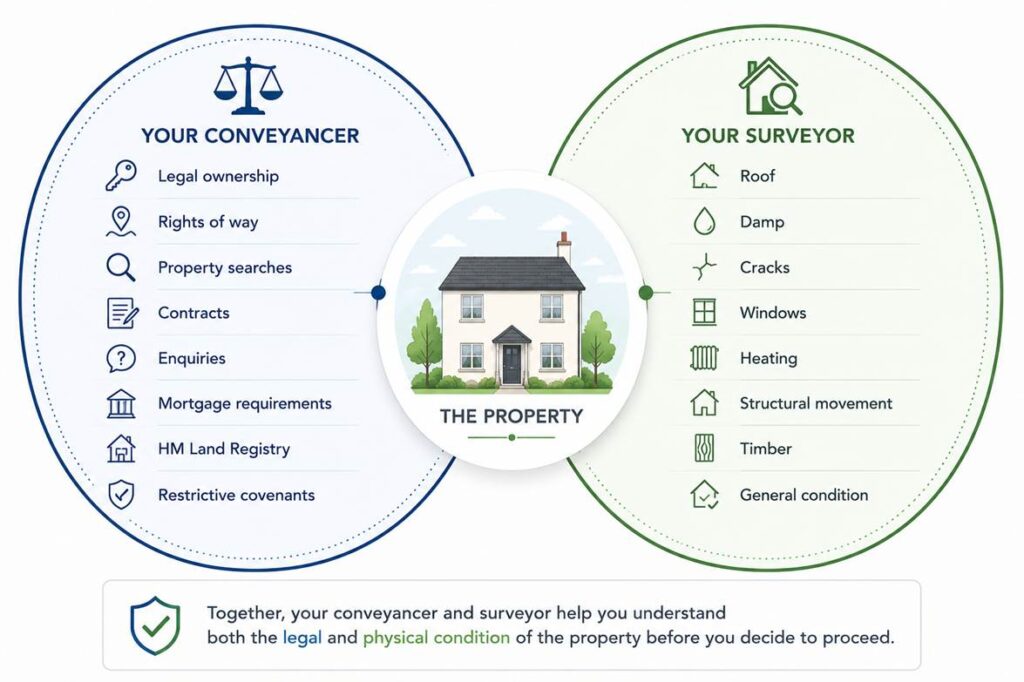
Common Questions
Is a mortgage valuation the same as a survey?
No.
A mortgage valuation is carried out for your lender to assess whether the property offers sufficient security for the mortgage. It isn’t a detailed inspection of the property’s condition and shouldn’t be relied upon as a survey.
Do I have to have a survey?
Not necessarily. Whether you choose to instruct a survey is entirely your decision. However, many buyers decide that a survey provides valuable information about the property’s condition before they become legally committed.
Will my conveyancer tell me if the property has structural problems?
Your conveyancer investigates the legal aspects of the transaction. They aren’t qualified to assess the physical condition of the property, which is why a survey can be an important part of the buying process.
Top Tip
Even if a property looks to be in excellent condition, some defects aren’t immediately visible. A survey can provide valuable information that may help you make an informed decision before Exchange of Contracts.
Did You Know?
Your conveyancer and your surveyor are investigating completely different aspects of the property. One looks at the legal position, the other looks at the physical condition.
Common Misconception
“I’m getting a mortgage, so I don’t need a survey.”
A mortgage valuation is primarily for the lender’s benefit. If you’d like a detailed assessment of the property’s condition, you should consider instructing your own survey.
The MA Lawyers Approach
At MA Lawyers, we’ll always explain the legal issues affecting your purchase in plain English. However, we also recognise the importance of understanding the property’s physical condition.
Whilst we don’t carry out surveys ourselves, we’ll work alongside your surveyor where necessary and, if your survey identifies legal issues requiring further investigation, we’ll discuss these with you and take any appropriate steps as part of your transaction.
Related Articles
- What Are Property Searches and Why Do I Need Them?
- What Enquiries Will My Conveyancer Raise?
- Why Do Transactions Take So Long?
- What Is Exchange of Contracts?
When you buy a property, you’ll spend countless hours viewing homes, comparing locations and imagining where your furniture will go.
But whilst you’re looking at the property you hope to buy, your conveyancer is looking at something very different.
Our job isn’t simply to complete paperwork or help you move house. It’s to investigate the property thoroughly, identify any legal issues, explain what they mean for you and make sure you have all the information you need before deciding whether to proceed.
Much of this work happens behind the scenes, which is why many clients don’t always realise just how much is involved.
The Short Answer
Your conveyancer’s role is to investigate the property, protect your legal interests and guide you safely through one of the biggest financial commitments you’ll ever make.
We review legal documents, carry out searches, raise enquiries, work with your mortgage lender (where applicable) and make sure you understand any issues before you become legally committed to buying the property.
Our aim is simple:
To help you move into your new home with confidence, knowing exactly what you’re buying.
The Explanation
When you visit a property, it’s completely natural to focus on what you can see.
The kitchen.
The garden.
The bedrooms.
Whether your sofa will fit.
Our role is very different.
We’re looking for everything you can’t see.
We’ll carefully investigate the legal title to confirm ownership, boundaries, rights of way, restrictions and any obligations that may affect the property.
We’ll review the contract papers prepared by the seller’s conveyancer, examine the Property Information Forms completed by the seller and check any supporting documents that have been provided.
We’ll arrange the appropriate property searches to identify matters such as planning history, highways, drainage, environmental issues and anything else that could affect the property or your future enjoyment of it.
If something isn’t clear, or further information is needed, we’ll raise enquiries with the seller’s conveyancer. Sometimes these are answered quickly. Sometimes they require additional documents or information from third parties.
If you’re buying with a mortgage, we’ll also act for your lender (provided we’re on their panel), ensuring the property satisfies their requirements before mortgage funds can be released.
Throughout the transaction, we’ll explain what we’ve found, answer your questions and advise you on any risks or matters that require your attention.
Only once we’ve completed our investigations, your enquiries have been satisfactorily answered, your mortgage conditions have been met (where applicable) and you’re happy to proceed will you be ready to Exchange Contracts.
What Are We Looking For?
Every property is different, but some of the matters we investigate may include:
- Who legally owns the property.
- Whether anyone else has rights over the property or access across it.
- Planning permissions and Building Regulations approvals for alterations.
- Restrictions affecting how the property can be used.
- Flood risk or environmental concerns identified by searches.
- Whether roads and sewers are publicly maintained.
- Lease terms, service charges and ground rent (where applicable).
- Mortgage lender requirements.
- Missing documents or certificates.
- Any issues that need further clarification before you commit to buying.
Most transactions don’t uncover major problems, but if something does arise, it’s our job to explain it clearly and discuss the options available to you.

Common Questions
Why does it sometimes seem quiet?
Because much of our work happens behind the scenes.
We’re reviewing legal documents, analysing search results, raising enquiries and waiting for information from other parties. Although you may not see that work happening, your transaction is often progressing every day.
Will you tell me if something is wrong?
Absolutely.
If we identify something that could affect your decision to proceed, we’ll explain it in plain English, discuss the risks and answer any questions you may have before you make any decisions.
Do you physically inspect the property?
No.
Your conveyancer investigates the legal aspects of the property, not its physical condition.
If you want advice about the property’s structural condition, you should consider instructing an independent surveyor to carry out a survey.
Why do you ask so many questions?
Because buying a property is often a once-in-a-generation decision.
The more information we obtain before Exchange of Contracts, the fewer surprises there should be after you’ve moved in.
Top Tip
Don’t worry if your conveyancer asks you questions or requests additional documents during the transaction.
Very often, we’re simply making sure we have everything needed to protect you before you become legally committed to the purchase.
Did You Know?
The majority of a conveyancer’s work takes place before Exchange of Contracts.
By the time you’re legally committed to buy the property, we’ve usually spent many hours investigating documents, reviewing search results, raising enquiries and making sure both you and your mortgage lender have the information needed to proceed safely.
Common Misconception
“Conveyancers just complete paperwork.”
This is one of the biggest misconceptions about conveyancing.
The documents are only part of our role.
Our real job is to investigate the property thoroughly, identify legal issues, explain what they mean and help you make an informed decision before you commit to buying.
The MA Lawyers Approach
At MA Lawyers, we believe buying a property should never feel like you’re signing documents you don’t fully understand.
Our role is to carry out the detailed legal investigations that protect your investment, whilst keeping you informed every step of the way.
We’ll explain what we’re doing, why we’re doing it and what it means for you in clear, straightforward language. If we identify an issue, we’ll discuss it with you openly, answer your questions and help you understand your options.
Most importantly, we never lose sight of what’s really at the centre of every transaction.
It isn’t just a property.
It’s your future home.
Related Articles
- What Is Conveyancing?
- My Offer Has Been Accepted. What Happens Next?
- When Should I Instruct My Conveyancer?
- What Are Property Searches?
- What Are Enquiries?
- What Is Exchange of Contracts?
Once the contract papers and property searches have been received, your conveyancer will usually raise pre-contract enquiries with the seller’s conveyancer.
This often prompts the question:
“What exactly are you asking?”
The answer is that every property is different. Whilst some enquiries are raised on almost every purchase, many are specific to the individual property, the documents received or issues identified during the legal investigations.
The purpose of enquiries isn’t to delay your purchase—it’s to make sure you have the information you need before deciding whether to proceed.
The Short Answer
Enquiries are questions raised with the seller’s conveyancer to clarify information about the property or to request documents that are missing or incomplete.
Some enquiries are straightforward, whilst others may require the seller to obtain information from third parties, such as managing agents, freeholders or the Local Authority.
The number of enquiries raised isn’t important. What matters is that your conveyancer has the information they need to properly advise you before Exchange of Contracts.
The Explanation
Your conveyancer will review the contract papers, title documents, property searches and the seller’s completed property information forms.
If anything is unclear, inconsistent or requires further clarification, enquiries will be raised.
For example, your conveyancer may ask about:
- Alterations or extensions carried out to the property.
- Missing planning permission or Building Regulations approval.
- Rights of way or shared access.
- Boundaries.
- Guarantees and warranties.
- Restrictive covenants.
- Service charges and ground rent (for leasehold properties).
- Management company information.
- Search results requiring clarification.
- Occupiers, tenants or vacant possession.
Every enquiry has a purpose. Sometimes it’s simply to obtain a missing document. Other times it’s to ensure there isn’t a legal issue that could affect your ownership or make the property difficult to sell in the future.
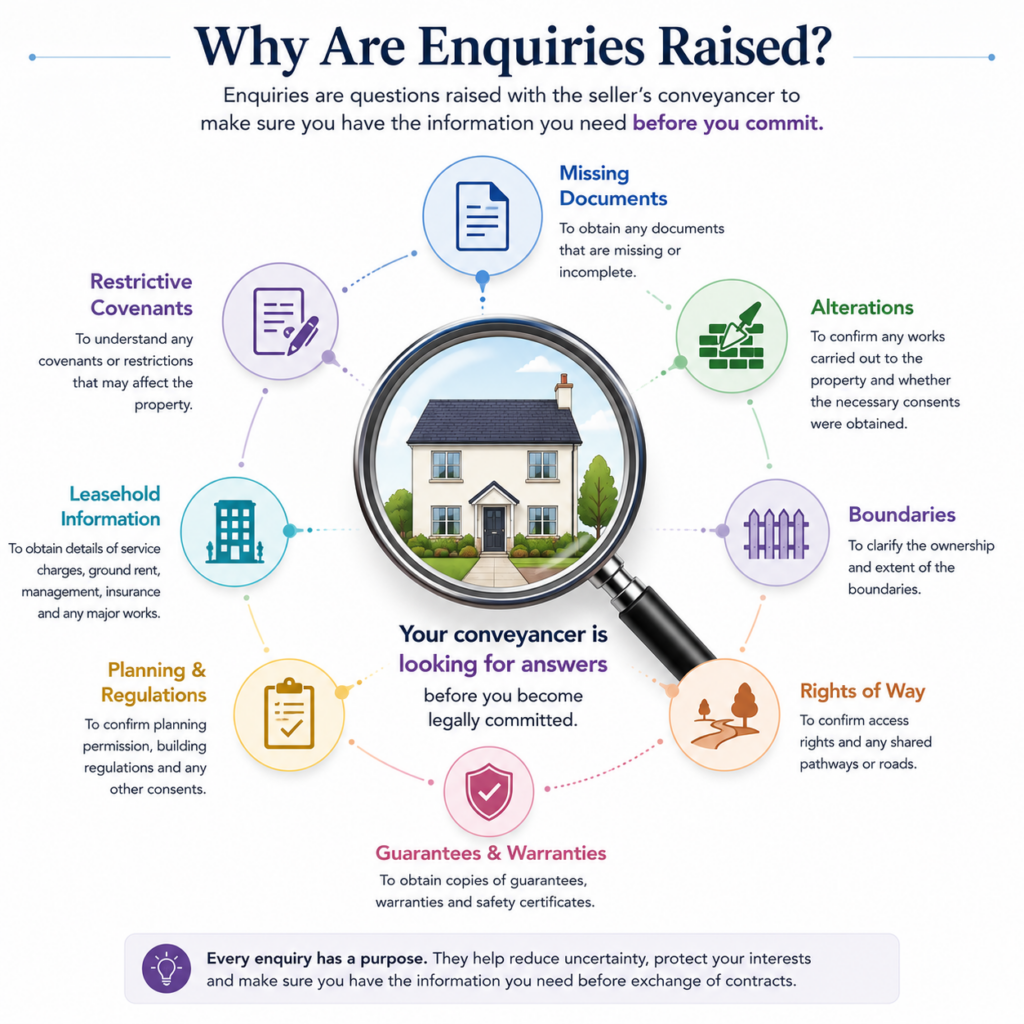
Common Questions
Can my conveyancer ask too many enquiries?
Your conveyancer will raise the enquiries they consider necessary based on the information available. Every enquiry should have a purpose and help clarify an aspect of the transaction.
Why is the seller taking so long to reply?
Some enquiries can be answered quickly, whilst others require the seller to obtain documents or information from third parties, such as managing agents, freeholders, Local Authorities or previous contractors.
What happens if an enquiry can’t be answered?
Your conveyancer will explain the position, discuss any risks with you and advise you on the options available before you decide how to proceed.
Top Tip
Try not to judge progress by the number of enquiries raised. A transaction with ten enquiries isn’t necessarily simpler than one with thirty. It’s the quality of the replies, not the quantity of the questions, that matters.
Did You Know?
Some enquiries are raised because of something discovered in the property searches, whilst others arise from the title documents, the seller’s forms or information revealed during the legal investigations.
Common Misconception
“Every conveyancer asks exactly the same enquiries.”
Not necessarily.
Whilst there are common enquiries raised in many transactions, every conveyancer will tailor their enquiries to the property they’re investigating and the issues they’ve identified.
That’s why no two transactions are ever exactly the same.
The MA Lawyers Approach
At MA Lawyers, we don’t believe in asking unnecessary questions simply for the sake of it.
Every enquiry we raise has a purpose. Our role is to investigate the property’s legal position thoroughly and ensure you have the information you need before Exchange of Contracts.
Where replies require further clarification, we’ll explain why additional enquiries are necessary and keep you informed throughout the process.
Related Articles
- What Are Property Searches and Why Do I Need Them?
- What Is a Survey and Do I Need One?
- Why Do Transactions Take So Long?
- What Is Exchange of Contracts?
Many sellers worry that having a mortgage will make selling their property more complicated.
Fortunately, in most cases, it doesn’t.
If you have a mortgage secured against your property, it’s perfectly normal. Your conveyancer will deal with the legal process of redeeming the mortgage as part of your sale, allowing ownership to be transferred to the buyer free from your lender’s legal charge.
Understanding how this works can help you know what to expect as your sale approaches completion.
The Short Answer
If you have a mortgage on your property, it will normally be repaid from the sale proceeds on the day of completion.
Before completion, your conveyancer will obtain a redemption statement from your lender confirming exactly how much is needed to repay your mortgage.
Once the sale has completed, your conveyancer will send the redemption money directly to your lender before transferring any remaining balance to you.
The Explanation
When you bought your property, your lender registered a legal charge against the title at HM Land Registry.
Before ownership can pass to the buyer, that legal charge must be removed.
Your conveyancer will therefore:
- Contact your lender for an up-to-date redemption statement.
- Check that the redemption figure will be covered by the sale proceeds.
- Redeem your mortgage immediately following completion.
- Ensure your lender releases its legal charge.
- Transfer any remaining balance of the sale proceeds to you.
If you’re buying another property at the same time, your sale proceeds can usually be used towards your onward purchase once your existing mortgage has been redeemed.
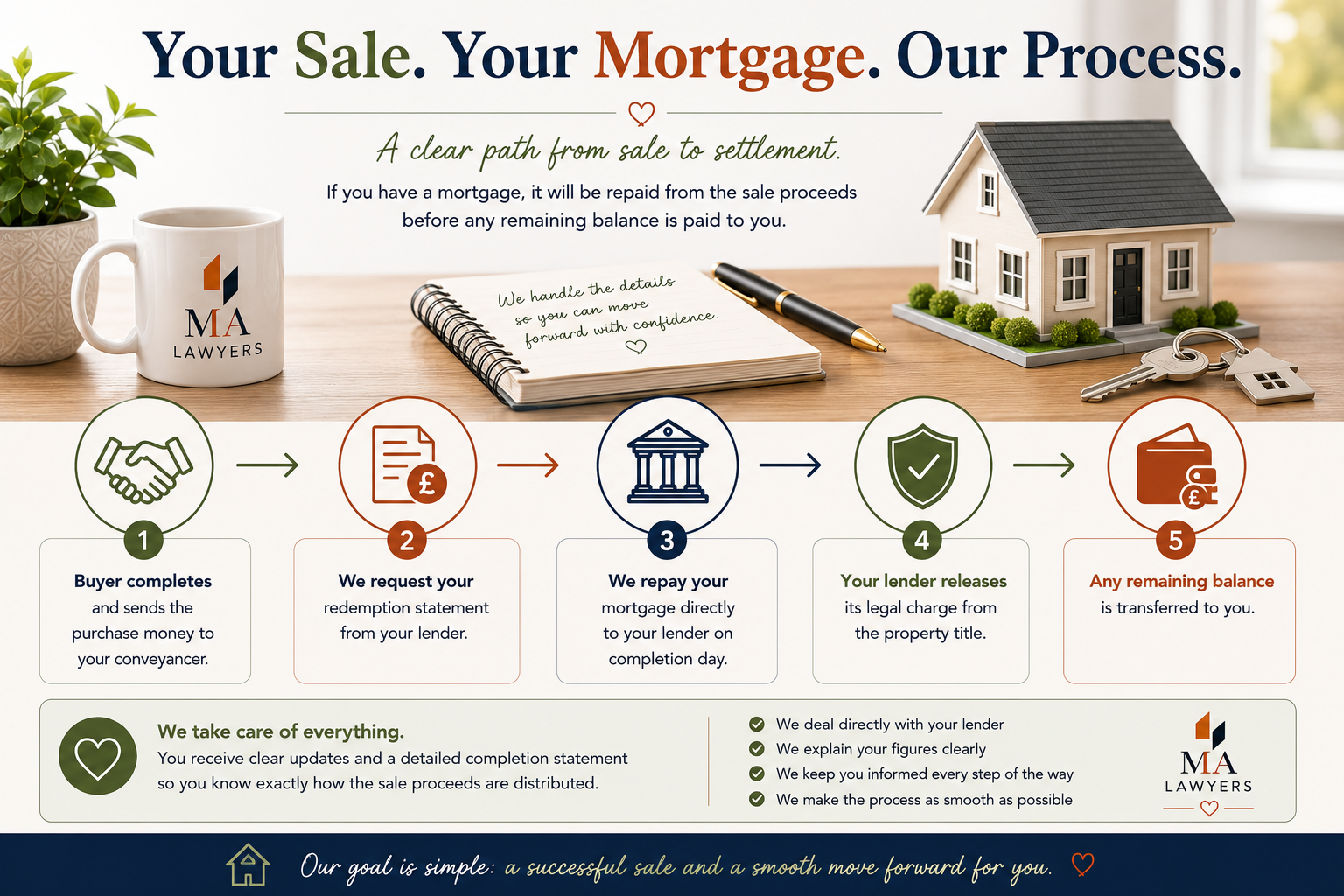
Common Questions
Will I need to contact my mortgage lender?
Usually not.
Your conveyancer will obtain the redemption statement and deal directly with your lender as part of the legal process.
What is a redemption statement?
A redemption statement confirms the exact amount required to repay your mortgage on a specific date.
It includes the outstanding balance together with any interest due up to the proposed completion date.
What if I’m buying another property?
If you’re selling and buying on the same day, your sale proceeds are normally used towards your purchase after your existing mortgage has been redeemed.
Could I have to pay an early repayment charge?
Possibly.
Some mortgage products include an early repayment charge if the mortgage is repaid before a particular date.
Your redemption statement will confirm whether any such charge applies.
Top Tip
If you’ve recently changed your mortgage product or you’re planning to port your mortgage to another property, let your conveyancer know as early as possible.
Did You Know?
Redemption figures are only valid for a limited period because mortgage interest usually continues to accrue daily until the mortgage is repaid.
Common Misconception
“The sale money comes straight to me.”
Not quite.
Your conveyancer must first repay your mortgage and deal with any authorised deductions before transferring the remaining balance to you.
The MA Lawyers Approach
At MA Lawyers, we’ll obtain your redemption statement, check the figures carefully and deal directly with your lender to ensure your mortgage is repaid correctly on completion.
We’ll explain your completion statement in advance so you know exactly how the sale proceeds will be distributed, giving you a clear understanding of what you’ll receive once your sale has completed.
Related Articles
- When Will I Receive My Sale Proceeds?
- Why Is My Sale Taking So Long?
- Why Can’t My Conveyancer Tell Me When We’ll Complete?
- What If My Buyer Pulls Out?
One of the first things your conveyancer is likely to ask about is your Source of Funds.
For many clients, this can sound like legal jargon, and it’s completely understandable to wonder exactly what it means.
You may have spent years saving for your deposit, received money from a family member, sold another property or built up savings through regular income. Whatever the source, your conveyancer needs to understand where the money for your transaction has come from.
This isn’t because we doubt you. It’s because the law requires us to ask.
The Short Answer
Source of Funds simply means where the money you are using for your property transaction has come from.
As a regulated law firm, we must understand how you have obtained the funds being used to buy your property or pay associated costs. This helps us comply with Anti-Money Laundering regulations and protects everyone involved in the transaction.
The Explanation
Every property transaction involves money changing hands, often significant sums.
Before we can proceed, we must be satisfied that the funds being used are legitimate and that we understand their origin.
Depending on your circumstances, your Source of Funds may include:
- Savings built up over time.
- Proceeds from the sale of another property.
- An inheritance.
- A gifted deposit from a family member.
- Employment income or a bonus.
- Investments that have been sold.
- Pension withdrawals.
- Business income.
Providing Source of Funds information doesn’t usually mean producing years of financial records. Instead, we’ll ask for enough evidence to demonstrate how the money has accumulated or become available for your purchase.
Sometimes this is straightforward. Other times, where funds have come from several different places or over a long period, we may need to ask additional questions or request further documents.
Our aim is simply to understand the journey your money has taken before it reaches your property transaction.
Common Examples of Source of Funds

| Source | Evidence We May Ask For |
| Savings | Bank or savings account statements |
| Sale of another property | Completion statement from your previous sale |
| Inheritance | Estate accounts, solicitor’s letter or bank statement |
| Gifted deposit | Gift letter and evidence from the person making the gift |
| Investments | Investment statement and evidence of sale |
| Pension | Pension statement or withdrawal confirmation |
| Bonus | Payslip or employer confirmation |
The documents required will depend on your individual circumstances.
Common Questions
Will I need to provide every bank statement I’ve ever had?
No. We will only ask for information that is relevant to understanding the funds being used for your transaction.
What if my money has come from more than one place?
That’s perfectly normal. Many purchases are funded by a combination of savings, gifts, mortgage funds and sale proceeds. We’ll simply ask for evidence of each source where appropriate.
What happens if I can’t provide the information straight away?
Let us know as soon as possible. We can explain what is needed and discuss whether alternative evidence may be available. Providing the requested information promptly helps avoid unnecessary delays.
Is this information kept confidential?
Yes. Any financial information you provide is handled securely and used solely for the purposes of your transaction and our legal and regulatory obligations.
Top Tip
If you’re planning to buy a property, try to keep the money you’re using in as few accounts as possible before instructing your conveyancer. A clear financial trail often makes the verification process quicker and simpler.
Did You Know?
A mortgage offer is not considered your Source of Funds. Your lender will provide the mortgage advance, but we must also understand where your own contribution to the purchase has come from.
Common Misconception
“Source of Funds means how much money I earn.”
Not necessarily.
Source of Funds is about where the money for this particular transaction has come from, not simply your salary or overall financial position.
The MA Lawyers Approach
At MA Lawyers, we’ll always explain why we’re asking for financial information and only request documents that are relevant to your transaction.
We appreciate that discussing finances can sometimes feel personal, so we’ll guide you through the process with sensitivity and explain what is needed at each stage. Completing these checks early helps avoid delays later in your transaction.
Related Articles
- Why Are You Asking Me for So Much Information?
- What’s the Difference Between Source of Funds and Source of Wealth?
- What Is a Gifted Deposit?
- When Should I Transfer My Money?
- What Is a Mortgage Offer?
Few things are more disappointing than hearing that a buyer has decided not to proceed.
After weeks, and sometimes months, of progressing a sale, it can feel like you’ve gone back to the beginning.
Whilst this can be frustrating, it doesn’t always mean the end of your sale. Understanding what happens next can help you make informed decisions and get your move back on track as quickly as possible.
The Short Answer
Until contracts have been exchanged, either the buyer or the seller can usually withdraw from the transaction without legal penalty.
If your buyer pulls out before Exchange of Contracts, your conveyancer will discuss your options with you, and your estate agent can usually begin remarketing the property if you decide to continue selling.
The Explanation
In England and Wales, accepting an offer does not create a legally binding contract.
That only happens when contracts are exchanged.
Before Exchange of Contracts, circumstances can change for a variety of reasons.
For example:
- The buyer’s mortgage application may be declined.
- A survey may reveal unexpected issues.
- The buyer’s own sale may fall through.
- Personal or financial circumstances may change.
- The buyer may simply decide not to proceed.
Whilst it’s understandably disappointing, it doesn’t necessarily mean your property won’t sell.
If your buyer withdraws, your conveyancer will advise you on the legal position, and your estate agent can discuss remarketing the property or progressing with another interested buyer if one is available.
Sometimes transactions recover surprisingly quickly, particularly where there are other prospective buyers.
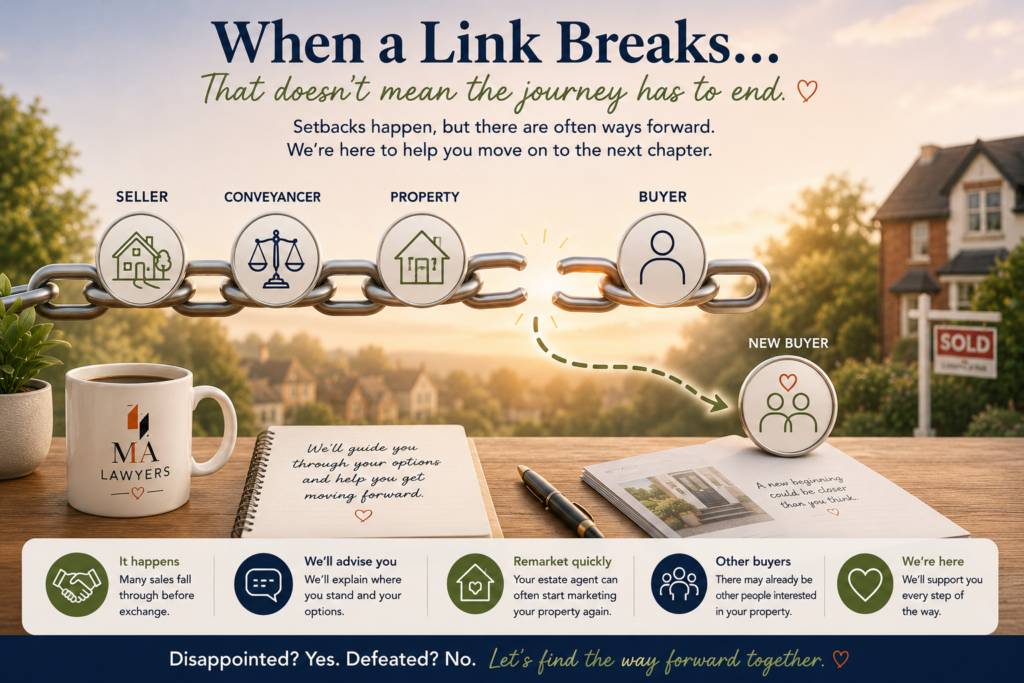
Common Questions
Will I lose my legal fees?
Some legal work will already have been carried out, so fees may be payable depending on how far the transaction has progressed and the terms of your agreement with your conveyancer.
Your conveyancer will explain the position to you.
Can I accept another offer straight away?
Yes.
If another buyer is available, you can usually proceed with them, subject to the usual conveyancing process.
Do I have to complete all the forms again?
Usually not.
In many cases, the information you’ve already provided can be used again, although it may need updating if circumstances have changed.
Can the buyer pull out after Exchange of Contracts?
Exchange of Contracts is the point at which the transaction becomes legally binding.
If a party fails to complete after Exchange, the legal consequences are very different.
Top Tip
If your estate agent tells you there’s interest from other buyers, don’t assume it’s bad news.
Having reserve interest can sometimes help if circumstances change before Exchange.
Did You Know?
Many sales that fall through before Exchange are successfully resold, sometimes to buyers who had previously viewed the property.
Common Misconception
“If my buyer pulls out, I’ve got to start everything again.”
Not necessarily.
Whilst a new buyer will need to carry out their own legal investigations, much of the work you’ve already completed—such as your property forms and supporting documents—can often still be used.
The MA Lawyers Approach
At MA Lawyers, we know how disappointing it can be when a buyer withdraws.
If it happens, we’ll explain exactly where your transaction stands, advise you on any legal implications and work with you and your estate agent to help get your sale moving again.
Our aim is to minimise disruption wherever possible so that, if you’re ready to continue selling, you’re in the best possible position to move forward.
Related Articles
- Why Is My Sale Taking So Long?
- What Enquiries Will the Buyer’s Conveyancer Raise?
- When Will I Receive My Sale Proceeds?
- What Is Exchange of Contracts? (Buying a Property)
The terms Source of Funds and Source of Wealth are often confused, and it’s easy to see why. They sound similar, but they mean two very different things.
Your conveyancer may ask questions about one or both, depending on the circumstances of your transaction and the information you provide.
Understanding the difference can make the process much less confusing and help you provide the right information first time.
The Short Answer
Source of Funds is where the money for this particular property transaction has come from.
Source of Wealth is how you accumulated your wealth over time.
In most transactions, we only need to establish your Source of Funds. However, in some circumstances, we may also need to understand your Source of Wealth to satisfy our legal and regulatory obligations.
The Explanation
Although the two terms sound alike, they answer two completely different questions.
Source of Funds asks:
“Where has the money you’re using today come from?”
For example:
- Savings.
- Sale proceeds from another property.
- An inheritance.
- A gifted deposit.
- Investments that have recently been sold.
It focuses on the money that will actually be used for your transaction.
Source of Wealth asks:
“How did you build your overall wealth?”
For example:
- Employment over many years.
- Running a successful business.
- Long-term investments.
- Property ownership.
- An inheritance received many years ago.
It looks at the bigger financial picture rather than the specific money being used for the purchase.
In many cases, Source of Wealth will never need to be explored in detail. However, where regulations require it, we may need to understand how your overall wealth was accumulated, particularly if there are unusual circumstances or higher-risk factors.
Source of Funds vs Source of Wealth

Common Questions
Why are you asking about my wealth when you’ve already seen my bank statements?
Bank statements help us understand where the purchase money has come from. In some situations, regulations also require us to understand how your wealth was accumulated over a longer period.
Will everyone be asked about their Source of Wealth?
No. Every transaction is different. Whether we need additional information depends on the circumstances and our regulatory obligations.
Does having savings automatically prove my Source of Wealth?
Not necessarily. Savings may demonstrate your Source of Funds, but if further checks are required, we may need to understand how those savings were built up over time.
Why does this matter?
These checks help protect the property market from financial crime and ensure that regulated law firms comply with Anti-Money Laundering legislation.
Top Tip
If you’re ever unsure whether we’re asking about your Source of Funds or your Source of Wealth, simply ask. We’ll explain exactly what information we need and why.
Did You Know?
Many clients only need to provide evidence of their Source of Funds. Requests for information about Source of Wealth are much less common and depend on the circumstances of the transaction.
Common Misconception
“Source of Funds and Source of Wealth mean the same thing.”
They don’t.
One explains where the money for this transaction has come from.
The other explains how your wealth has been accumulated over time.
The MA Lawyers Approach
At MA Lawyers, we’ll only ask for the information that is necessary for your transaction and our legal obligations.
Where additional information is required, we’ll explain why we’re asking and guide you through the process. Our aim is to make these checks as straightforward and understandable as possible, while ensuring your transaction progresses smoothly and remains fully compliant.
Related Articles
- Why Are You Asking Me for So Much Information?
- What Is Source of Funds?
- What Is a Gifted Deposit?
- When Should I Transfer My Money?
- Why Doesn’t MA Lawyers Calculate Stamp Duty?
Buying a property is exciting, and once your offer has been accepted it’s only natural to want everything to happen as quickly as possible.
One of the questions we’re asked most often is:
“Why is my purchase taking so long?”
The simple answer is that a property transaction doesn’t depend on just one person. It involves a number of different people and organisations, each carrying out their own part of the process before your purchase can move forward.
Whilst your conveyancer will continue progressing everything they can, there will often be stages where they’re waiting for information from others before the next step can be taken.
The Short Answer
Every property transaction is different.
Some purchases progress quickly, whilst others take longer because they’re waiting for information, documents or replies from one or more of the people involved.
A delay doesn’t necessarily mean something has gone wrong. More often than not, it simply means one part of the process is still being completed.
The Explanation
Conveyancing isn’t a single task—it’s a series of legal investigations, checks and communications that often happen at the same time.
During your purchase, your conveyancer may be waiting for:
- Property searches to be returned.
- Replies to enquiries from the seller’s conveyancer.
- A mortgage offer from your lender.
- Information from a managing agent or freeholder.
- Survey results.
- Documents from the seller.
- Confirmation from the Local Authority or other organisations.
In many cases, several of these things are happening simultaneously.
Your conveyancer will continue progressing every aspect of your transaction that they can, but some stages simply cannot move forward until the necessary information has been received.
That’s why two transactions, even on the same street, can progress at very different speeds.
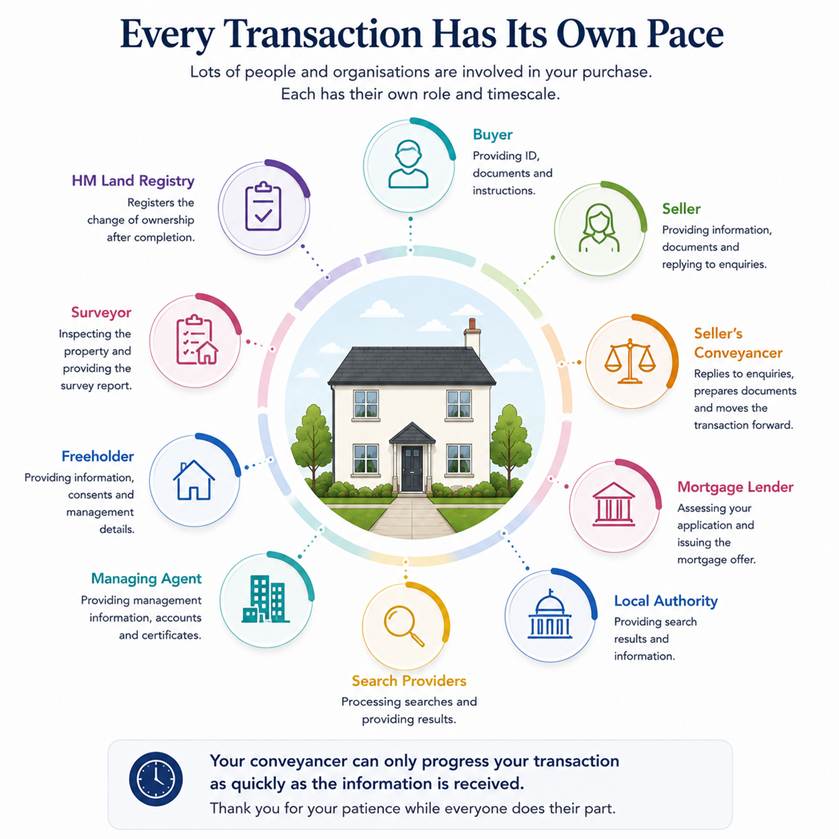
Common Questions
Has something gone wrong if I haven’t heard anything for a few days?
Not necessarily.
There are often periods where your conveyancer is waiting for information from third parties. During this time, they may also be reviewing documents, progressing other aspects of your transaction or preparing for the next stage.
If there’s something you need to know or we need information from you, we’ll be in touch.
Can my conveyancer speed things up?
Your conveyancer will do everything they reasonably can to progress your transaction, including chasing outstanding replies and keeping in contact with the other parties involved.
However, they can’t control how quickly third parties respond.
What causes the biggest delays?
Every transaction is different, but common causes include:
- Waiting for search results.
- Delays in receiving mortgage offers.
- Outstanding enquiries.
- Leasehold management information.
- Property chains.
- Missing documents.
- Waiting for all parties to be ready to exchange.
Top Tip
One of the best ways you can help keep your purchase moving is by responding promptly whenever your conveyancer asks you for information or documents.
Did You Know?
A straightforward purchase may involve communication with your mortgage lender, the seller’s conveyancer, estate agents, search providers, surveyors, managing agents, freeholders, HM Land Registry and several other organisations—all before you receive the keys.
Common Misconception
“My conveyancer is doing nothing because I haven’t had an update.”
Much of the work involved in conveyancing happens behind the scenes.
Your conveyancer may be reviewing legal documents, raising enquiries, checking replies, speaking with third parties or preparing reports whilst waiting for information that allows the next stage of the transaction to progress.
The MA Lawyers Approach
At MA Lawyers, we appreciate that waiting can sometimes be the most frustrating part of buying a property.
Our approach is to keep your transaction progressing wherever possible, communicate with the people and organisations involved, and explain matters in plain English.
Whilst we can’t control how quickly third parties respond, we can ensure that your file continues to move forward whenever the opportunity arises. If there’s a significant development, or we need something from you, we’ll let you know.
Related Articles
I’ve Completed – What Happens Next?
What Enquiries Will My Conveyancer Raise?
What Is Exchange of Contracts?
What Happens on Completion Day?
One of the most common questions we are asked is:
“When should I send my money?”
Whether you’re paying your deposit, transferring your balance for completion or sending funds for legal fees and disbursements, it’s important to know when to transfer money and why timing matters.
Sending funds too early may not be necessary, while leaving it until the last minute can cause unnecessary stress and, in some cases, delay completion.
The good news is that we’ll guide you through exactly what is needed and when.
The Short Answer
You should only transfer money when your conveyancer asks you to.
Throughout your transaction, we’ll let you know:
- how much to send;
- when it’s needed;
- where it should be sent;
- and how to do so safely.
We appreciate that transferring large sums of money can feel daunting, so we’ll ensure you have clear instructions before making any payment.
The Explanation
During your transaction, there may be several occasions when you need to transfer money.
For example:
- Money on account when you first instruct us (where applicable).
- Your exchange deposit.
- Your balance required for completion.
- Additional sums if your Completion Statement changes.
We will never expect you to guess these amounts.
Before requesting any payment, we’ll provide you with a Completion Statement or written confirmation showing exactly what is due.
Because banks can have transfer limits and processing times, we recommend arranging your payment in good time, particularly if you’re transferring a large amount.
Receiving cleared funds before completion helps ensure your transaction can proceed as planned.
When Might You Need to Send Money?
| Stage | What You May Be Asked to Pay |
| At the beginning of the transaction | Money on account (where applicable) |
| Before Exchange of Contracts | Exchange deposit |
| Before Completion | Balance required to complete |
| Occasionally during the transaction | Additional costs or disbursements if applicable |

We’ll always explain what each payment relates to before asking you to transfer any money. Additionally, we will always invite you to call to verify the bank details before making any payment to ensure you have confidence and peace of mind.
Common Questions
Can I send the money early?
We generally recommend waiting until we ask you to transfer funds. This helps ensure you’re sending the correct amount at the appropriate stage of your transaction.
Can I make more than one transfer?
Yes. Many clients transfer funds in stages, particularly where bank transfer limits apply.
What if my bank has a daily transfer limit?
Many banks do have transfer limits. If this applies to you, let us know as early as possible so we can help you plan your payments.
Will you tell me your bank details by email?
We’ll explain our procedures for providing bank details and how to verify them safely. If you are ever unsure, please telephone us using a trusted number before sending any money.
Top Tip
Before transferring any money, always take a moment to verify the bank details using a trusted method. Property transactions are sometimes targeted by fraudsters, and a simple telephone call can provide valuable reassurance.
Did You Know?
Many banks have daily online transfer limits. If you’re sending a large sum, you may need to make several payments or arrange the transfer with your bank in advance.
Common Misconception
“I’ll send the money as soon as I instruct my conveyancer.”
Not necessarily.
We’ll tell you exactly what is needed and when. In most cases, there is no benefit in transferring large sums before they are required.
The MA Lawyers Approach
At MA Lawyers, we understand that transferring significant amounts of money can feel overwhelming.
We’ll provide clear payment instructions, explain exactly what each payment is for and let you know when funds are needed. If you have any concerns, we’re always happy to talk you through the process before you make a transfer.
Related Articles
- What Is Source of Funds?
- What’s the Difference Between Source of Funds and Source of Wealth?
- What Is a Gifted Deposit?
- What Is a Mortgage Offer?
- Why Doesn’t MA Lawyers Calculate Stamp Duty?
As you move through your property purchase, you’ll often hear people talking about “Exchange of Contracts.”
It’s one of the most important milestones in the conveyancing process because it’s the point at which your purchase becomes legally binding.
Until contracts are exchanged, either party can usually withdraw from the transaction. Once exchange has taken place, both the buyer and seller are committed to completing the sale on the agreed date.
Understanding what Exchange of Contracts means will help you know why your conveyancer carries out so many checks before reaching this stage.
The Short Answer
Exchange of Contracts is the point at which the buyer and seller become legally committed to the transaction.
Before Exchange, either party can usually withdraw.
After Exchange, both parties are legally bound to complete the transaction on the agreed completion date, unless the contract provides otherwise.
The Explanation
Before contracts are exchanged, your conveyancer will make sure that all legal investigations have been completed and that you’re in a position to proceed.
This usually includes:
- Reviewing the legal title.
- Receiving satisfactory property searches.
- Considering replies to enquiries.
- Receiving your mortgage offer (where applicable).
- Receiving your signed contract.
- Holding your deposit (where required).
- Agreeing a completion date with all parties involved.
Once everyone is ready, the buyer’s conveyancer and the seller’s conveyancer will formally exchange contracts.
This doesn’t usually involve everyone meeting together. Instead, it’s normally carried out by telephone using an agreed legal procedure.
Once Exchange has taken place, both parties are legally committed to completing the transaction on the agreed completion date.
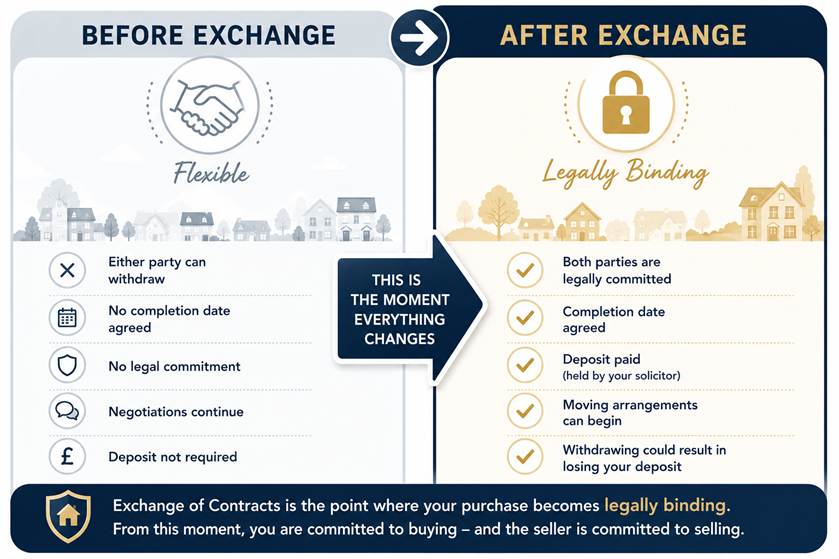
Common Questions
Can I pull out before Exchange of Contracts?
In most circumstances, yes.
Until contracts have been exchanged, either the buyer or seller can usually decide not to proceed. Whilst this can be disappointing, there is generally no legal obligation to continue before Exchange.
Can the seller accept another offer before Exchange?
Potentially, yes.
Until contracts have been exchanged, neither party is legally committed to the transaction. Although uncommon once matters are progressing well, it is possible for circumstances to change before Exchange.
Do I need buildings insurance before Exchange?
This depends on the terms of the contract and the type of property you’re buying.
Your conveyancer will advise you when you should arrange buildings insurance so that you’re properly protected.
Can I book my removals before Exchange?
It’s usually sensible to wait until Exchange of Contracts has taken place.
Whilst everyone may be working towards a proposed completion date, dates can change before Exchange. Booking removals too early could result in cancellation or rearrangement costs if the transaction is delayed.
Top Tip
Try not to make irreversible arrangements, such as booking removals, giving notice on a rental property or arranging time off work, until your conveyancer confirms that contracts have been exchanged.
Did You Know?
Although it’s called Exchange of Contracts, the buyer and seller rarely meet each other. In most cases, the exchange is carried out by the conveyancers over the telephone using an established legal procedure.
Common Misconception
“Once my offer has been accepted, the property is mine.”
Unfortunately, that’s not the case.
An accepted offer is an important step, but neither party is legally committed until Exchange of Contracts has taken place.
The MA Lawyers Approach
Exchange of Contracts is one of the most significant stages of your purchase, so we believe it should never be rushed.
At MA Lawyers, we’ll only recommend proceeding to Exchange once we’ve completed our legal investigations, answered your questions and ensured you understand the commitments you’re making.
We’ll explain exactly what Exchange means, confirm the agreed completion date and make sure you’re fully prepared before your transaction becomes legally binding.
Related Articles
- Why Is My Purchase Taking So Long?
- What Happens on Completion Day?
- I’ve Completed – What Happens Next?
- What Enquiries Will My Conveyancer Raise?
It’s one of the questions we hear most often:
“Why is everything taking so long?”
When you’ve accepted an offer and you’re ready to move, it’s natural to hope that everything will progress quickly.
The reality is that buying and selling property involves many different people, organisations and legal processes. Whilst some transactions complete within a matter of weeks, others take longer because everyone involved has to reach the same point before the sale can move forward.
Waiting can be frustrating, but it doesn’t always mean that something has gone wrong.
The Short Answer
Property transactions involve many different people working towards the same goal.
Your conveyancer can only progress your sale as quickly as the information becomes available.
Delays are often caused by factors outside your conveyancer’s control, such as waiting for search results, mortgage offers, replies from third parties or other transactions within the property chain.
The Explanation
Every property transaction is unique.
Some progress quickly because the paperwork is straightforward, there is no chain and everyone responds promptly.
Others naturally take longer because more information is required or additional parties become involved.
For example, your transaction may depend on:
- The buyer’s mortgage lender issuing a mortgage offer.
- The buyer’s survey identifying further questions.
- Replies to legal enquiries.
- Leasehold information from managing agents or landlords.
- Search results.
- A management company providing information.
- Other buyers and sellers within the property chain.
- Local authorities or third-party organisations.
- HM Land Registry applications or title issues.
Your conveyancer continues working on your file throughout the transaction, even when it may appear that nothing is happening.
Sometimes progress is visible.
Sometimes it’s happening behind the scenes.

Common Questions
Has something gone wrong if it’s taking longer than expected?
Not necessarily.
Many transactions simply take longer because information is still being gathered or other parties are progressing their own part of the transaction.
Why does it seem quiet for days or weeks?
Some stages involve waiting for replies from other organisations or professionals.
During this time, your conveyancer will continue reviewing information as it arrives and progressing anything that can be dealt with.
Can my conveyancer make other people respond more quickly?
Your conveyancer will chase outstanding information where appropriate, but they can’t control how quickly third parties respond.
Can I do anything to help?
Yes.
Returning documents promptly, responding to requests for information and keeping your conveyancer informed of any changes can all help avoid unnecessary delays.
Top Tip
Whenever you receive a request from your conveyancer, try to respond as soon as you reasonably can.
Even small delays in returning documents or answering questions can sometimes affect the overall progress of the transaction.
Did You Know?
Even the simplest property transaction may involve dozens of different people and organisations working together before contracts can be exchanged.
Common Misconception
“Nothing is happening because I haven’t heard from my conveyancer.”
Not necessarily.
Much of a conveyancer’s work happens behind the scenes—reviewing documents, raising enquiries, speaking with other professionals and waiting for information that allows the next stage of the transaction to begin.
The MA Lawyers Approach
At MA Lawyers, we know that waiting can often be the most difficult part of selling a property.
We’ll continue progressing every aspect of your transaction that we can, review information as it arrives and keep in touch whenever there’s meaningful progress or we need something from you.
Our focus is always on moving your sale forward wherever possible, whilst recognising that some parts of the process depend on other people and organisations.
Related Articles
- Why Can’t My Conveyancer Tell Me When We’ll Complete?
- What Enquiries Will the Buyer’s Conveyancer Raise?
- What Happens If I Have a Mortgage?
- When Will I Receive My Sale Proceeds?
Congratulations!
You’ve collected the keys, moved into your new home and can finally begin enjoying it.
For many people, this feels like the end of the conveyancing journey.
In reality, whilst you’ve completed your purchase, there’s still a little more work for us to do behind the scenes before everything is finalised.
The good news is that, in most cases, there’s nothing more you need to do. We’ll take care of the remaining legal formalities and let you know once everything has been completed.
The Short Answer
Although you’ve now moved into your new home, your conveyancer still has some important legal work to complete.
This includes dealing with any Stamp Duty Land Tax requirements (where applicable), submitting your application to HM Land Registry and registering you as the new legal owner of the property.
The Explanation
Once completion has taken place and you’ve collected the keys, our work continues behind the scenes.
If Stamp Duty Land Tax is payable, or a return is required, this will need to be dealt with shortly after completion. At MA Lawyers, this process is managed by our specialist tax consultants, Compass, who will have contacted you during your transaction where necessary.
Once this has been completed, we’ll prepare your application to HM Land Registry.
This application registers you as the new legal owner of the property and, where applicable, registers your mortgage lender’s legal charge against the title.
HM Land Registry will then process the application.
Registration times vary considerably depending on the type of application and HM Land Registry’s current workload. Some applications are completed within a few weeks, whilst others may take several months.
Whilst you may not hear much during this stage, there’s usually no cause for concern. Once your application has been submitted, your interest in the property is protected whilst HM Land Registry completes its work.
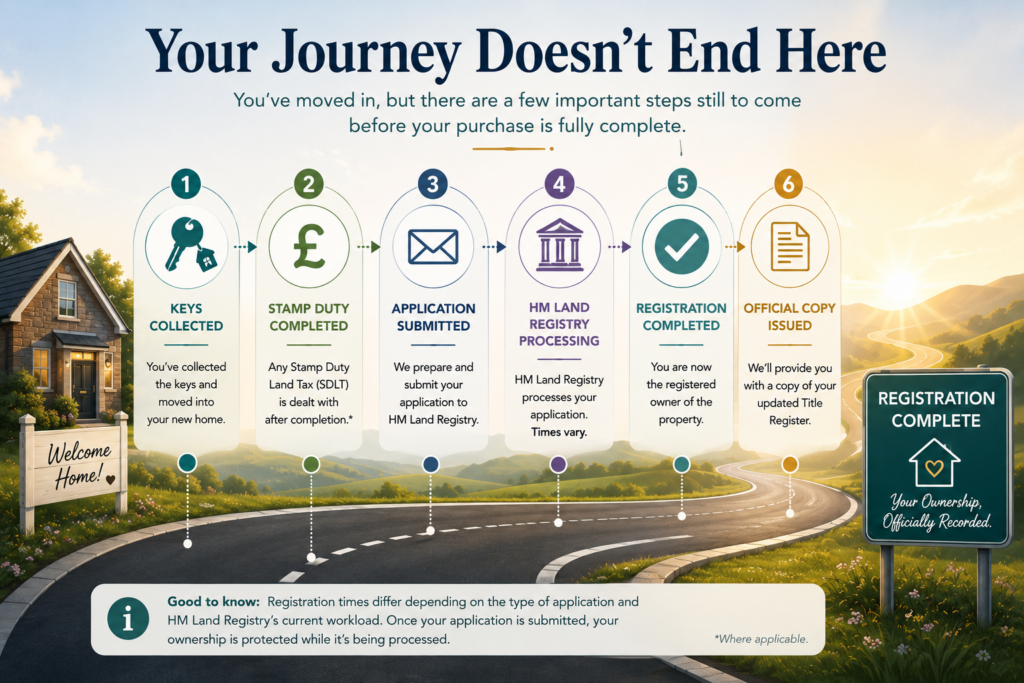
Common Questions
Do I need to do anything after completion?
Usually not.
Once you’ve moved in, we’ll deal with the remaining legal work. If we need anything further from you, we’ll contact you.
When will I receive confirmation that I’m the registered owner?
We’ll let you know once HM Land Registry has completed your application and provide you with a copy of your updated Title Register for your records.
How long does registration take?
Registration times vary depending on the type of application and HM Land Registry’s workload.
Whilst some applications are completed relatively quickly, others can take several months.
We’ll continue to monitor the application until registration has been completed.
Do I need my old paper title deeds?
Not usually.
Today, ownership is recorded electronically at HM Land Registry. Your updated Title Register becomes the official record of your ownership.
Top Tip
Keep your updated Title Register somewhere safe once you receive it. It’s often useful when you come to sell, remortgage or carry out work to your property in the future.
Did You Know?
Most people never need to contact HM Land Registry directly.
Your conveyancer deals with the application on your behalf and will let you know once your registration has been completed.
Common Misconception
“Once I’ve collected the keys, my conveyancer has finished.”
Not quite.
Completion is a major milestone, but there’s still important legal work to be completed before your purchase is fully concluded.
The MA Lawyers Approach
At MA Lawyers, collecting your keys isn’t the end of our service.
We’ll continue working behind the scenes to complete the final legal formalities, submit your application to HM Land Registry and monitor your registration until it’s complete.
Once everything has been finalised, we’ll provide you with confirmation that you’re the registered owner together with a copy of your updated Title Register.
Our job isn’t simply to get you through the front door, it’s to make sure your ownership has been properly protected and recorded.
Related Articles
- What Happens on Completion Day?
- What Is Exchange of Contracts?
- Why Are You Asking Me for So Much Information? (Money Explained)
- Leasehold Explained
It’s one of the most common questions in conveyancing:
“Can you tell me when we’ll complete?”
We completely understand why people ask.
Whether you’re arranging removals, booking time off work, organising school places or simply looking forward to moving into your next home, knowing the completion date feels incredibly important.
The difficulty is that a completion date isn’t something your conveyancer can decide alone.
It can only be agreed when everyone involved in the transaction is legally and practically ready.
The Short Answer
Your conveyancer can’t confirm a completion date until all parties in the transaction are ready to proceed.
Before a date can be agreed, legal work must be completed, enquiries answered, mortgage funds (where applicable) arranged and, if there’s a chain, every linked transaction must also be ready.
Until then, any suggested date is simply a target rather than a confirmed completion date.
The Explanation
A completion date isn’t chosen by one person.
It’s agreed between everyone involved in the transaction.
Before that can happen, several important stages usually need to be completed, including:
- The buyer’s legal investigations.
- Replies to enquiries being received and approved.
- Mortgage offers being issued (where applicable).
- Searches and any additional investigations being completed.
- Leasehold information being received (where applicable).
- Contracts being approved by both conveyancers.
- Every linked transaction within the property chain reaching the same stage.
Only once these matters have been dealt with can the parties discuss and agree a completion date.
Even then, everyone in the chain must be available on the same day.
This is why your conveyancer may sometimes be unable to give you a definite date, even though significant progress has already been made.

Common Questions
Can’t you just give me an estimated completion date?
We can often give you an indication based on how the transaction is progressing.
However, until everyone is ready, any date remains an estimate and could change.
Why can’t we just pick a date now?
Because other parties may still be waiting for mortgage offers, search results, replies to enquiries or information from third parties.
Choosing a date too early can lead to disappointment if something unexpected delays the transaction.
When will the completion date usually be agreed?
In many cases, the date is agreed shortly before Exchange of Contracts, once everyone is satisfied that they’re ready to proceed.
Can I book my removals before the completion date is confirmed?
It’s usually safer to wait until contracts have been exchanged and a completion date has been formally agreed.
Booking removals too early could result in cancellation or rearrangement costs if the date changes.
Top Tip
If you’re making arrangements for removals, annual leave or school transfers, speak to your conveyancer first.
We’ll let you know when it’s appropriate to start making firm bookings.
Did You Know?
A property chain can involve several separate transactions.
Even if your own sale is ready, the completion date often depends on every linked transaction reaching the same stage.
Common Misconception
“My conveyancer already knows the completion date but isn’t telling me.”
Not at all.
If we could give you a confirmed completion date sooner, we absolutely would.
The reality is that the date depends on everyone involved reaching the finish line together.
The MA Lawyers Approach
At MA Lawyers, we understand how important it is to have as much certainty as possible.
Whilst we won’t promise a completion date before it’s ready to be agreed, we’ll always keep you informed about the progress of your transaction and explain what still needs to happen before a date can be confirmed.
When the time is right, we’ll work with the other conveyancers, estate agents and everyone else involved to agree a completion date that’s suitable for all parties.
Our aim is to give you clear information and realistic expectations, helping you plan your move with confidence rather than uncertainty.
Related Articles
- Why Is My Sale Taking So Long?
- What Happens If I Have a Mortgage?
- When Will I Receive My Sale Proceeds?
- What Happens on Completion Day? (Buying a Property)
If you’re buying a property, you’ve probably heard of Stamp Duty Land Tax (SDLT) and may expect your conveyancer to calculate how much you’ll need to pay.
Many law firms still do.
However, at MA Lawyers, we’ve taken a different approach.
Rather than providing tax calculations ourselves, we work with specialist Stamp Duty experts to ensure you receive accurate advice based on your individual circumstances.
You might wonder why we’ve made that decision.
The answer is simple: we believe you should receive specialist tax advice from specialists.
The Short Answer
MA Lawyers no longer calculate Stamp Duty Land Tax because SDLT is a complex area of tax law.
Instead, we work in partnership with C%mpass, a specialist SDLT consultancy, who calculate your Stamp Duty, advise on your liability and deal with the HMRC submission.
This means your SDLT is handled by dedicated tax specialists while we remain focused on progressing the legal aspects of your property transaction.
The Explanation
Although SDLT forms part of many property transactions, it is ultimately a tax.
Modern Stamp Duty legislation has become increasingly complex, with different rules applying depending on factors such as:
- whether you already own property;
- whether you’re replacing your main residence;
- whether the property is residential or commercial;
- mixed-use property;
- companies and trusts;
- first-time buyers;
- non-UK residents;
- and many other individual circumstances.
Rather than asking our conveyancers to act as tax advisers, we’ve chosen to work alongside C%mpass, whose team specialises in Stamp Duty Land Tax.
C%mpass will:
- contact you directly;
- ask questions about your circumstances;
- calculate your SDLT liability;
- explain how the calculation has been reached;
- submit the SDLT return to HMRC; and
- provide the necessary confirmation once this has been completed.
This approach provides you with the reassurance that your Stamp Duty has been assessed by specialists in this area.
Why We’ve Chosen This Approach
| MA Lawyers | C%mpass |
| Deals with the legal conveyancing transaction | Specialises exclusively in Stamp Duty Land Tax |
| Reviews contracts, title and legal documentation | Calculates your SDLT liability |
| Liaises with your lender and the other conveyancer | Submits your SDLT return to HMRC |
| Guides your property transaction from instruction to completion | Provides specialist SDLT expertise |
Together, we ensure that both the legal and tax aspects of your purchase are handled by professionals specialising in their respective fields.

Common Questions
Does this mean I’ll have to deal with two companies?
Yes, but only for your Stamp Duty.
C%mpass will contact you directly to collect the information needed for your SDLT calculation. We’ll continue to deal with every other aspect of your conveyancing transaction and will work closely with C%mpass where necessary.
Is there an additional fee?
Yes.
As detailed in our estimate, C%mpass charges a specialist fee for calculating and submitting your SDLT return. We’ll explain this cost to you at the outset of your transaction.
Can C%mpass answer my Stamp Duty questions?
Yes.
Because SDLT is their specialist area, they are best placed to advise you on your individual tax position.
How do I know C%mpass is genuine?
C%mpass is a specialist SDLT provider working with conveyancing firms across England and Wales. If MA Lawyers has referred you to C%mpass, you can also find our firm listed as one of their partner firms on the C%mpass website.
Top Tip
If C%mpass contacts you with questions about your circumstances, respond as fully and accurately as possible. Small details can sometimes affect the amount of Stamp Duty payable.
Did You Know?
Stamp Duty is a tax, not a legal fee. That’s why MA Lawyers believes it should be dealt with by professionals who specialise in tax rather than asking conveyancers to provide tax advice.
Common Misconception
“My conveyancer should calculate my Stamp Duty.”
Not necessarily.
Many firms now choose to work with specialist SDLT providers because of the increasing complexity of tax legislation.
At MA Lawyers, we’ve chosen to work with C%mpass so our clients receive specialist SDLT support alongside specialist conveyancing advice.
The MA Lawyers Approach
At MA Lawyers, we believe every aspect of your transaction should be handled by the right specialist.
Our role is to guide the legal side of your purchase from instruction through to completion.
For Stamp Duty Land Tax, we’ve chosen to work alongside C%mpass because tax law deserves specialist knowledge.
By combining our conveyancing expertise with C%mpass’s SDLT expertise, we can offer a service that gives our clients confidence that both the legal and tax elements of their purchase are being handled by experienced professionals.
Related Articles
- Why Are You Asking Me for So Much Information?
- What Is Source of Funds?
- What’s the Difference Between Source of Funds and Source of Wealth?
- What Is a Gifted Deposit?
- When Should I Transfer My Money?
- What Is a Mortgage Offer?
As your sale progresses, one question is never far away:
“When will I receive my money?”
Whether you’re buying another property, paying off a mortgage or simply waiting for the funds to reach your bank account, it’s completely understandable to want to know when the sale proceeds will arrive.
The good news is that, in most cases, the money is transferred on the day of completion. However, there are a few important steps that need to happen before the funds can be sent to you.
The Short Answer
Once your sale has completed, the buyer’s conveyancer sends the purchase money to your conveyancer.
Your conveyancer will then:
- Redeem any mortgage secured against the property (if applicable).
- Pay any agreed estate agent’s fees (where instructed).
- Deduct any agreed legal costs and disbursements.
- Transfer the remaining balance of the sale proceeds to your nominated bank account.
We’ll provide you with a Completion Statement showing exactly how the money has been calculated before completion takes place.
The Explanation
Completion takes place when the buyer’s conveyancer transfers the purchase money to your conveyancer.
Once those funds have been safely received, your conveyancer will carry out several important checks before sending your money to you.
This usually includes:
- Confirming that completion has taken place.
- Redeeming any mortgage on the property.
- Paying any agreed fees and disbursements.
- Preparing the final completion statement.
- Transferring your remaining sale proceeds by bank transfer.
The exact time you receive the funds will depend on when completion takes place, how quickly the banking system processes the transfer and whether there are any other transactions linked to your sale.
If you’re also buying another property on the same day, your sale proceeds will usually be used towards your purchase before any remaining balance is transferred to you.
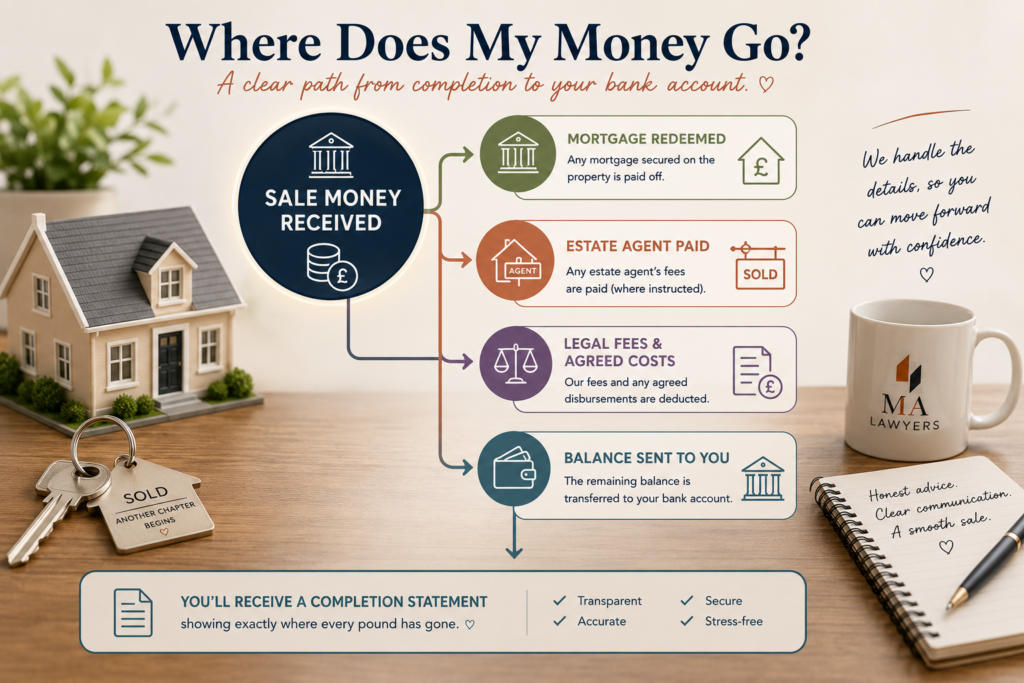
Common Questions
Will I receive all of the sale price?
Not always.
If you have a mortgage, it will normally need to be repaid from the sale proceeds. Your legal fees, agreed disbursements and any other authorised payments will also be deducted before the remaining balance is transferred to you.
Can the money be sent to someone else’s bank account?
For your security, we’ll discuss your payment instructions with you during the transaction and explain any verification requirements before completion.
How will I know how much I’m receiving?
Before completion, we’ll provide you with a Completion Statement showing the sale price, any deductions and the balance due to you.
Will I receive the money on the same day?
In most cases, yes.
Once completion has taken place and we’ve completed the necessary financial checks, we’ll arrange for the balance due to you to be transferred as soon as possible.
Top Tip
If your bank account details change during the transaction, let your conveyancer know as soon as possible.
For your protection, we may need to verify any changes before completion.
Did You Know?
Your conveyancer doesn’t simply receive the money and press “send.”
Several financial checks must be completed first to ensure the correct amounts are paid to the correct people before the balance is transferred to you.
Common Misconception
“The sale money comes straight to me.”
Not quite.
The purchase money is first received by your conveyancer, who must deal with any mortgage redemption, agreed payments and legal formalities before sending the remaining balance to you.
The MA Lawyers Approach
At MA Lawyers, we understand that completion day is often the day you’ve been waiting for.
Before completion, we’ll provide you with a clear Completion Statement so you know exactly what to expect.
Once completion has taken place and the necessary financial checks have been completed, we’ll arrange for your sale proceeds to be transferred to your nominated bank account as soon as possible.
If you’re using the funds to buy another property, we’ll ensure the money is transferred as part of your onward purchase in accordance with your instructions.
Related Articles
- Why Do I Have to Complete So Many Forms?
- What Happens If My Buyer Pulls Out?
- Why Is My Sale Taking So Long?
- What Happens on Completion Day? (Buying a Property)