
Once the contract papers and property searches have been received, your conveyancer will usually raise pre-contract enquiries with the seller's conveyancer.
This often prompts the question:
"What exactly are you asking?"
The answer is that every property is different. Whilst some enquiries are raised on almost every purchase, many are specific to the individual property, the documents received or issues identified during the legal investigations.
The purpose of enquiries isn't to delay your purchase—it's to make sure you have the information you need before deciding whether to proceed.
The Short Answer
Enquiries are questions raised with the seller's conveyancer to clarify information about the property or to request documents that are missing or incomplete.
Some enquiries are straightforward, whilst others may require the seller to obtain information from third parties, such as managing agents, freeholders or the Local Authority.
The number of enquiries raised isn't important. What matters is that your conveyancer has the information they need to properly advise you before Exchange of Contracts.
The Explanation
Your conveyancer will review the contract papers, title documents, property searches and the seller's completed property information forms.
If anything is unclear, inconsistent or requires further clarification, enquiries will be raised.
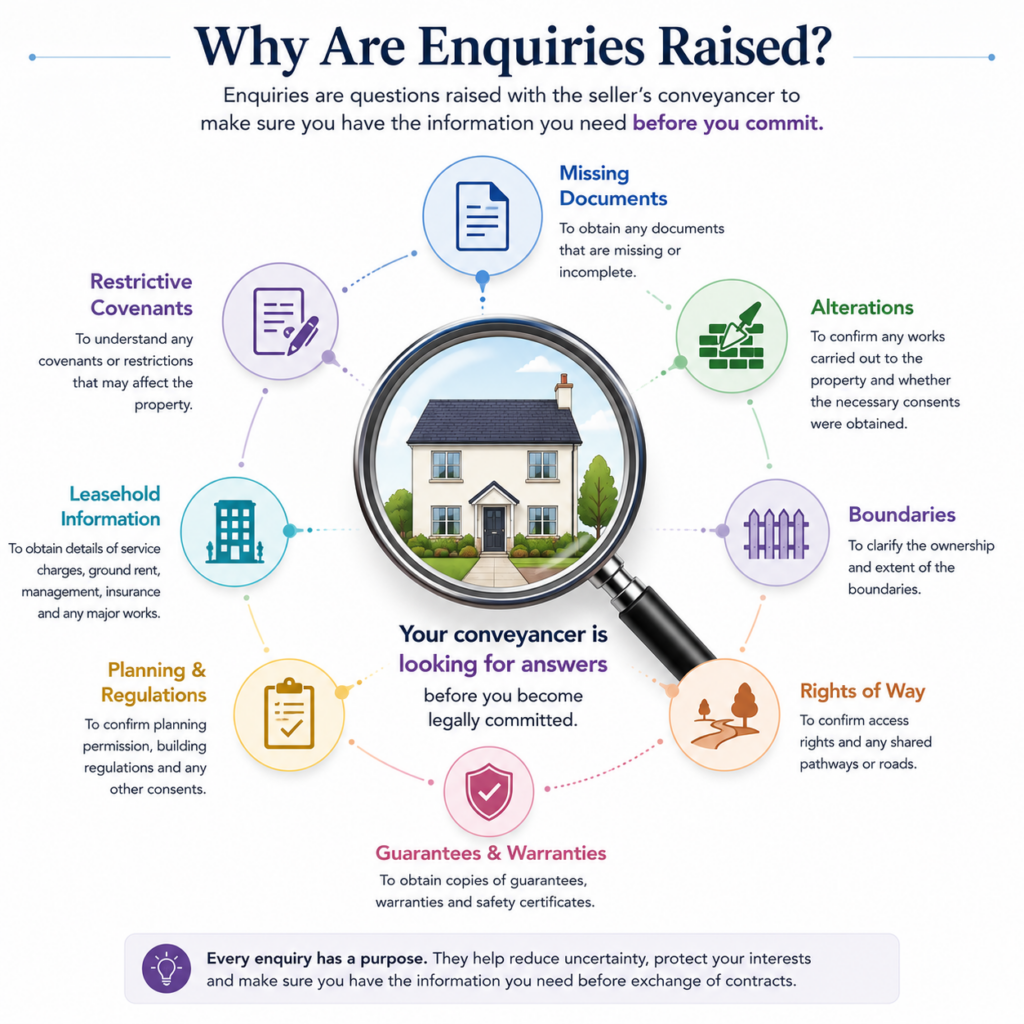
For example, your conveyancer may ask about:
- Alterations or extensions carried out to the property.
- Missing planning permission or Building Regulations approval.
- Rights of way or shared access.
- Boundaries.
- Guarantees and warranties.
- Restrictive covenants.
- Service charges and ground rent (for leasehold properties).
- Management company information.
- Search results requiring clarification.
- Occupiers, tenants or vacant possession.
Every enquiry has a purpose. Sometimes it's simply to obtain a missing document. Other times it's to ensure there isn't a legal issue that could affect your ownership or make the property difficult to sell in the future.
Common Questions
Can my conveyancer ask too many enquiries?
Your conveyancer will raise the enquiries they consider necessary based on the information available. Every enquiry should have a purpose and help clarify an aspect of the transaction.
Why is the seller taking so long to reply?
Some enquiries can be answered quickly, whilst others require the seller to obtain documents or information from third parties, such as managing agents, freeholders, Local Authorities or previous contractors.
What happens if an enquiry can't be answered?
Your conveyancer will explain the position, discuss any risks with you and advise you on the options available before you decide how to proceed.
Top Tip
Try not to judge progress by the number of enquiries raised. A transaction with ten enquiries isn't necessarily simpler than one with thirty. It's the quality of the replies, not the quantity of the questions, that matters.
Did You Know?
Some enquiries are raised because of something discovered in the property searches, whilst others arise from the title documents, the seller's forms or information revealed during the legal investigations.
Common Misconception
"Every conveyancer asks exactly the same enquiries."
Not necessarily.
Whilst there are common enquiries raised in many transactions, every conveyancer will tailor their enquiries to the property they're investigating and the issues they've identified.
That's why no two transactions are ever exactly the same.
The MA Lawyers Approach
At MA Lawyers, we don't believe in asking unnecessary questions simply for the sake of it.
Every enquiry we raise has a purpose. Our role is to investigate the property's legal position thoroughly and ensure you have the information you need before Exchange of Contracts.
Where replies require further clarification, we'll explain why additional enquiries are necessary and keep you informed throughout the process.
Related Articles
- What Are Property Searches and Why Do I Need Them?
- What Is a Survey and Do I Need One?
- Why Do Transactions Take So Long?
- What Is Exchange of Contracts?