Accepting an offer on your property is an exciting milestone, but it's also the point where the legal work really begins.
Many sellers assume that once an offer has been accepted, the hard part is over. In reality, there's still a lot to do before contracts can be exchanged and your sale can be completed.
The good news is that your conveyancer will guide you through each stage, explain what's happening and let you know if they need anything from you along the way.
The Short Answer
Once you've accepted an offer, your conveyancer will begin preparing the legal paperwork needed for the sale.
This includes obtaining your title documents, preparing the draft contract, reviewing the information you provide about the property and sending the contract pack to the buyer's conveyancer.
The buyer's conveyancer will then begin their legal investigations before deciding what further enquiries they need to raise.
The Explanation
Once you've instructed your conveyancer, they'll start preparing your sale.
This usually involves:
Obtaining your title documents from HM Land Registry.
Preparing the draft contract.
Asking you to complete the Property Information Form and, where applicable, the Fittings and Contents Form and Leasehold Information Form.
Reviewing the information you've provided.
Obtaining any additional documents that may be needed.
Sending the contract pack to the buyer's conveyancer.
Once the buyer's conveyancer receives the contract pack, they'll begin reviewing the legal title and supporting documents before raising any enquiries.
Whilst this is happening, there may also be other things progressing behind the scenes, such as the buyer arranging their mortgage, searches and survey.
Your conveyancer will continue progressing your sale wherever possible and will contact you if anything further is needed.
Common Questions
Do I need a conveyancer before accepting an offer?
No.
However, once you've accepted an offer, instructing your conveyancer promptly allows the legal work to begin without unnecessary delay.
What forms will I need to complete?
Most sellers will be asked to complete forms about the property, including information about boundaries, disputes, guarantees, alterations and what fixtures and fittings are included in the sale.
If you're selling a leasehold property, you'll usually be asked to complete additional leasehold information.
Can anything be done before the buyer is ready?
Yes.
Preparing the contract pack and completing the property forms early can often help reduce delays later in the transaction.
Top Tip
Complete your property forms carefully and honestly.
If you're unsure about any question, ask your conveyancer rather than guessing. Clear and accurate information at the start can help avoid unnecessary enquiries later.
Did You Know?
The buyer's conveyancer can't begin their legal investigations until they've received the contract pack from the seller's conveyancer.
Preparing it promptly is one of the first opportunities to help keep your transaction moving.
Common Misconception
"I've accepted an offer, so everything is agreed."
Accepting an offer is an important milestone, but there are still legal investigations, enquiries and contracts to deal with before either party becomes legally committed.
The MA Lawyers Approach
At MA Lawyers, we like to get your sale moving as quickly as possible.
As soon as we're instructed, we'll begin preparing your contract pack, review the information you've provided and issue the legal papers to the buyer's conveyancer without unnecessary delay.
Starting the legal work early often helps prevent avoidable delays later in the transaction and gives your buyer the information they need to begin their legal investigations.
Many sellers are surprised when they hear that the buyer's conveyancer has raised enquiries.
It's common to wonder:
"Haven't I already completed all the forms?"
or
"Why are they asking so many questions?"
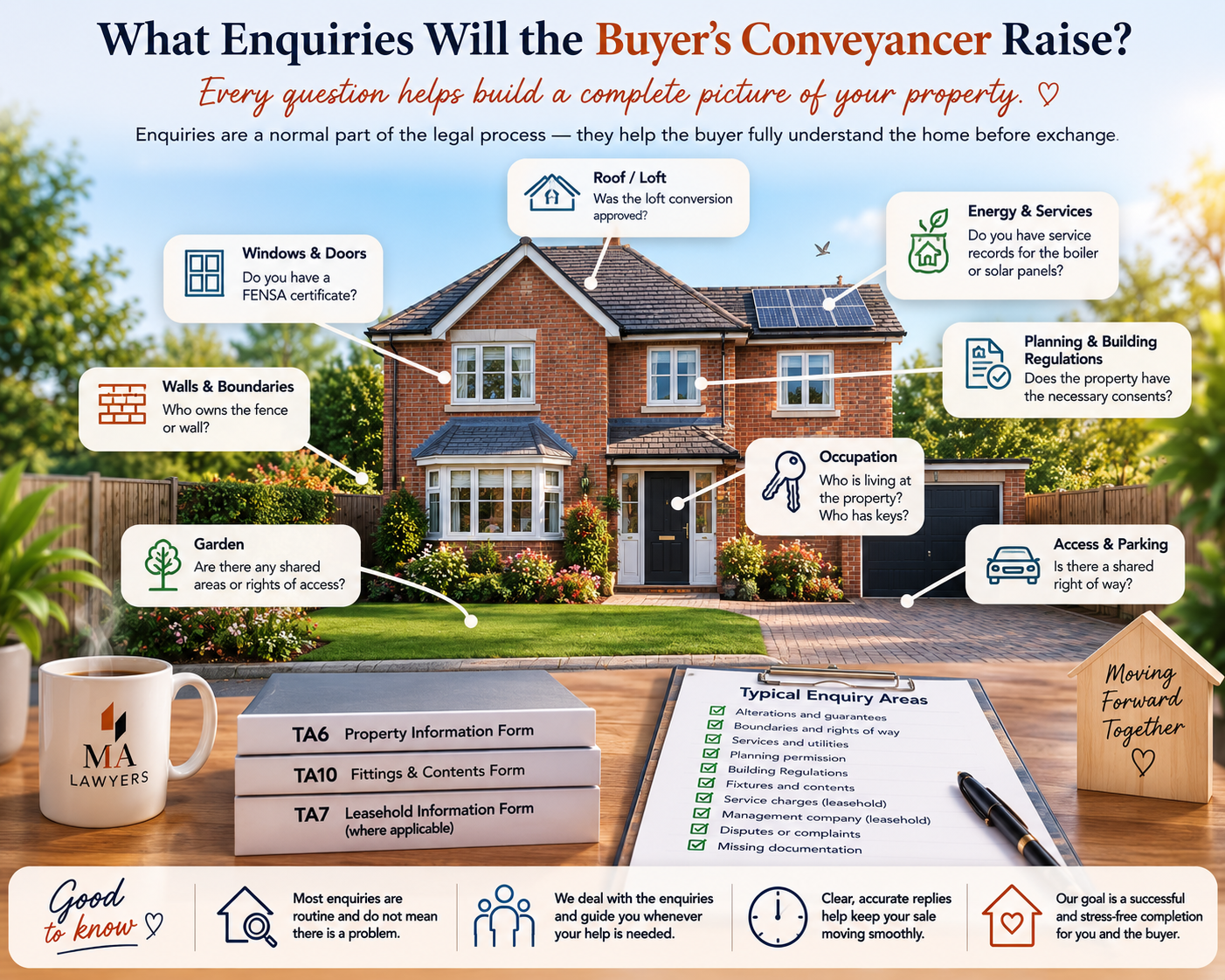
The truth is that enquiries are a normal part of almost every property transaction. They help the buyer understand the property, clarify anything that isn't clear from the paperwork and ensure they have the information they need before deciding whether to proceed.
Most enquiries are entirely routine and don't mean there's a problem with your sale.
The Short Answer
The buyer's conveyancer will review the title documents, the property forms, the contract papers, search results and any supporting documents before raising any enquiries.
Some enquiries are standard and arise on almost every transaction, whilst others are specific to your property.
Your conveyancer will review the enquiries, explain anything that requires your input and prepare the replies on your behalf.
The Explanation
Once the buyer's conveyancer has received the contract pack, they'll begin investigating the legal title to your property.
They'll compare the information you've provided with the legal documents and look for anything that needs clarification.
For example, they may ask about:
Alterations or extensions to the property.
Planning permission or Building Regulations approval.
Guarantees and warranties.
Rights of way or shared access.
Boundaries.
Disputes or complaints.
Fixtures and fittings.
Service charges and ground rent (for leasehold properties).
Management company information.
Occupiers at the property.
Mortgage redemption arrangements.
Missing paperwork or certificates.
Not every seller will receive the same enquiries.
Some properties generate very few questions, whilst older properties, leasehold homes or properties that have been altered may naturally require further clarification.
The important thing to remember is that enquiries are simply part of the legal process. They allow the buyer's conveyancer to report fully to their client before contracts are exchanged.
Common Questions
Have the enquiries been raised because there's a problem?
Usually not.
Most enquiries are routine and arise because the buyer's conveyancer is carrying out their legal investigations thoroughly.
Do I have to answer every enquiry myself?
Not necessarily.
Many enquiries are answered by your conveyancer using the legal documents already available. Where your knowledge is needed, we'll explain exactly what information we're asking you to provide.
What if I don't know the answer?
That's perfectly acceptable.
If you're unsure, let us know. It's always better to say you don't know than to guess.
We'll discuss whether the information can be obtained from another source or whether a different response is appropriate.
Why are they asking about something that happened years ago?
The buyer's conveyancer is trying to establish the legal position of the property, not just what's happened recently.
Sometimes historic alterations, guarantees or legal documents remain relevant even if the work was carried out many years ago.
Top Tip
If you have certificates, guarantees, planning permissions or Building Regulations approvals, keep them together from the outset.
Having them ready often allows enquiries to be answered much more quickly.
Did You Know?
Many enquiries can be answered before they're even raised if the seller provides clear, complete information and supporting documents at the beginning of the transaction.
Common Misconception
"The buyer's conveyancer is trying to make the sale fall through."
Almost never.
Their job is to protect their client's interests by ensuring they have all the information they need before becoming legally committed to buying the property.
The MA Lawyers Approach
At MA Lawyers, we review every enquiry carefully before sending it to you.
Many enquiries can be answered using the legal paperwork we already hold, meaning you won't be asked to deal with matters unnecessarily.
Where we do need your help, we'll explain what the enquiry means, why it's being asked and exactly what information we're looking for.
Our aim is to provide clear, accurate replies that help keep your sale progressing while ensuring the buyer has the information they need to make an informed decision.
Selling your home is an exciting step, but it's often at this stage that many sellers ask:
"Why do I have to complete so many forms?"
At first glance, it can feel like you're being asked to repeat information or answer questions that no one else seems to have to answer.
In reality, these forms are one of the most important parts of the conveyancing process. They help the buyer understand your home, reduce uncertainty and often prevent unnecessary delays later in the transaction.
Think of them as your opportunity to tell the buyer the story of your property.
The Short Answer
The property forms provide important information about your home that isn't shown on the title documents or visible during a viewing.
They help answer many of the buyer's questions before they need to ask them, making the conveyancing process smoother for everyone involved.
Completing the forms carefully and honestly can often reduce the number of additional enquiries raised later in the transaction.
The Explanation
When you sell your property, your conveyancer will ask you to complete several forms.
These will usually include:
TA6 – Property Information Form, covering matters such as boundaries, disputes, notices, alterations, guarantees and services.
TA10 – Fittings and Contents Form, confirming exactly what is included in the sale and what you intend to take with you.
TA7 – Leasehold Information Form, if you're selling a leasehold property, providing additional information about service charges, ground rent, insurance and the management of the building.
These forms aren't simply paperwork.
They're designed to give the buyer clear, accurate information about your property before they become legally committed to buying it.
Many of the questions may seem obvious to you because you've lived in the property, but the buyer is seeing it from the outside. Information that you take for granted could be something they need to know before deciding to proceed.
If you're unsure how to answer a question, don't worry. It's always better to ask your conveyancer than to guess.
Common Questions
Do I have to answer every question?
You should answer every question as fully and accurately as you can.
If you genuinely don't know the answer, or you're unsure, tell your conveyancer. They'll advise you on the best way to respond.
What if I can't remember when work was carried out?
That's perfectly understandable.
Provide as much information as you reasonably can and let your conveyancer know if you're uncertain about dates or details.
What happens if I've lost certificates or guarantees?
Don't panic.
Many sellers no longer have every document relating to their property.
Tell your conveyancer what's missing. Depending on the document, there may be alternative ways of dealing with the issue.
Why do the buyer's conveyancers still ask enquiries if I've completed the forms?
The forms provide an excellent starting point, but they don't answer every legal question.
The buyer's conveyancer will review your answers alongside the title documents, searches and any other information received. If anything needs clarification, they'll raise additional enquiries.
Top Tip
Set aside some uninterrupted time to complete the forms.
Rushing through them or guessing answers can often lead to additional enquiries later, whereas clear and accurate information at the outset helps keep your sale progressing smoothly.
Did You Know?
Many enquiries raised during a sale arise because information is missing, unclear or inconsistent. Carefully completed property forms can often answer those questions efore they're even asked.
Common Misconception
"These forms are just paperwork."
Not at all.
They're one of the buyer's main sources of information about your property and form an important part of the legal contract between buyer and seller.
That's why it's so important that they're completed honestly and accurately.
The MA Lawyers Approach
At MA Lawyers, we know that the property forms can seem daunting, particularly if you're selling a home you've lived in for many years.
We'll explain what each form is for, answer any questions you may have and guide you if you're unsure how to answer something.
Our aim isn't simply to collect paperwork—it's to help you provide the buyer with clear, accurate information that allows the transaction to progress with confidence.
A little extra care when completing the forms at the beginning can often save a great deal of time later in the transaction.
"I've lost the paperwork... is that going to stop my sale?"
Whether it's a missing FENSA certificate, a boiler guarantee, Building Regulations approval or another important document, it's understandable to worry that your sale might be delayed.
The good news is that missing paperwork doesn't automatically mean your sale can't proceed.
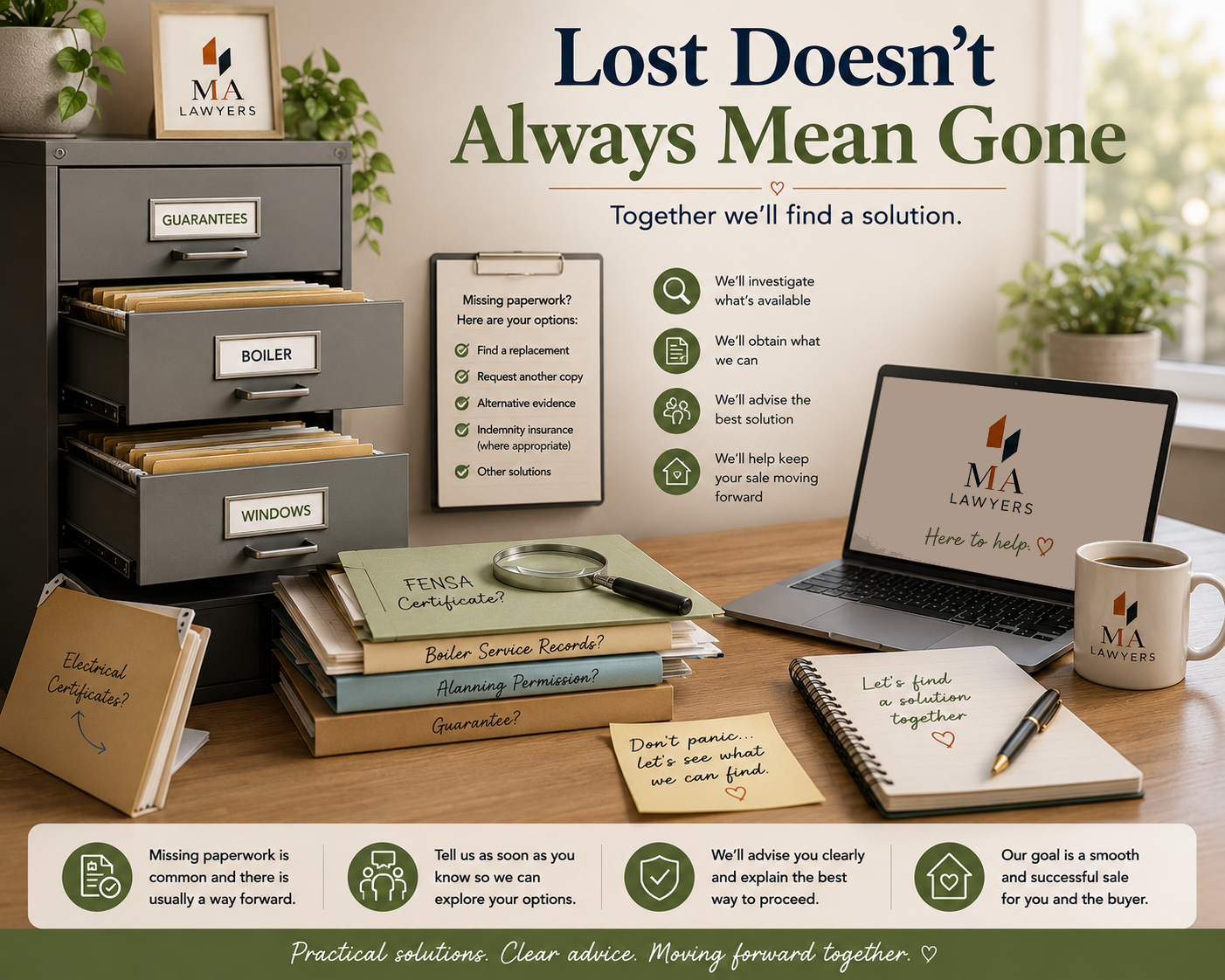
In many cases, there are practical ways of dealing with the issue, and your conveyancer will discuss the available options with you.
The Short Answer
If you've lost paperwork relating to your property, don't panic.
Tell your conveyancer as soon as possible.
Depending on what's missing, the document may be available from another source, an alternative document may be acceptable, or another solution may be available to allow the transaction to continue.
The Explanation
Many homeowners assume they still have every document they received when they bought their property or carried out improvements.
In reality, people move house, change computers, replace filing systems and occasionally misplace paperwork.
Some of the documents commonly requested during a sale include:
FENSA certificates.
Building Regulations approvals.
Planning permission.
Boiler installation certificates.
Electrical Installation Certificates.
Gas Safe certificates.
Damp proofing or timber treatment guarantees.
NHBC or new build warranties.
Other guarantees or warranties.
Losing one of these documents doesn't necessarily prevent you from selling your home.
Sometimes the information can be obtained from the original installer or issuing organisation. In other cases, the buyer may accept alternative evidence or another solution may be available.
Every situation is different, which is why it's important to tell your conveyancer as soon as you become aware that something is missing.
Common Questions
Will my sale fall through if I've lost a certificate?
Not necessarily.
Many missing documents can be replaced or alternative solutions may be available, depending on the circumstances.
Can I get another copy?
Sometimes.
Many installers, manufacturers and organisations keep records and may be able to provide replacement certificates or confirmation of work carried out.
Should I tell my conveyancer straight away?
Yes.
The earlier we know something is missing, the sooner we can discuss the options and, where possible, avoid unnecessary delays later in the transaction.
What if the paperwork never existed?
Tell your conveyancer.
Depending on the circumstances, there may still be ways of progressing the transaction, although this will depend on the nature of the missing document and the buyer's requirements.
Top Tip
If you know you've carried out work to your property, spend a little time looking for any paperwork before the sale begins.
Even if you can't find everything, knowing what's available from the outset can help your conveyancer prepare for any questions that may arise.
Did You Know?
Some documents can still be obtained many years after the work was carried out, particularly where installers or local authorities retain records.
Common Misconception
"If I can't find the paperwork, I can't sell my house."
That's rarely the case.
Missing paperwork is a common issue in conveyancing, and whilst it may need to be addressed, it doesn't automatically prevent a sale from proceeding.
The MA Lawyers Approach
At MA Lawyers, we know that very few homeowners have kept every piece of paperwork relating to their property.
If something is missing, we'll explain why it's being requested, discuss whether it can be obtained from another source and advise you on the options available.
Every situation is different, and our role is to help find a practical solution wherever possible so your transaction can continue progressing.
Related Articles
Why Do I Have to Complete So Many Forms?
What Enquiries Will the Buyer's Conveyancer Raise?
Many sellers worry that having a mortgage will make selling their property more complicated.
Fortunately, in most cases, it doesn't.
If you have a mortgage secured against your property, it's perfectly normal. Your conveyancer will deal with the legal process of redeeming the mortgage as part of your sale, allowing ownership to be transferred to the buyer free from your lender's legal charge.
Understanding how this works can help you know what to expect as your sale approaches completion.
The Short Answer
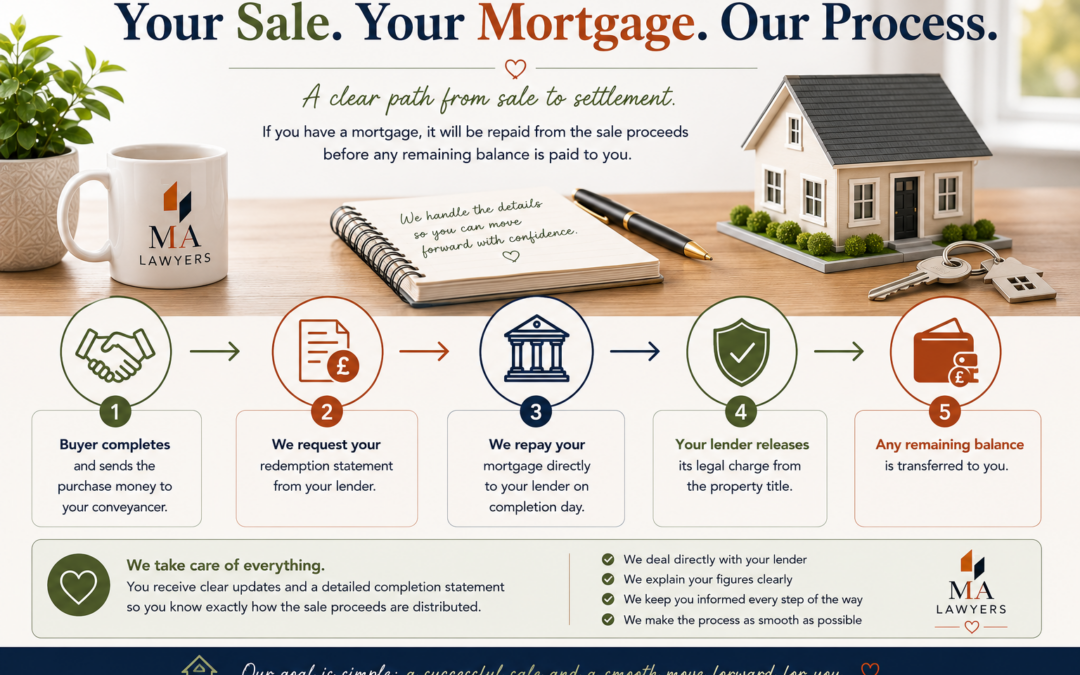
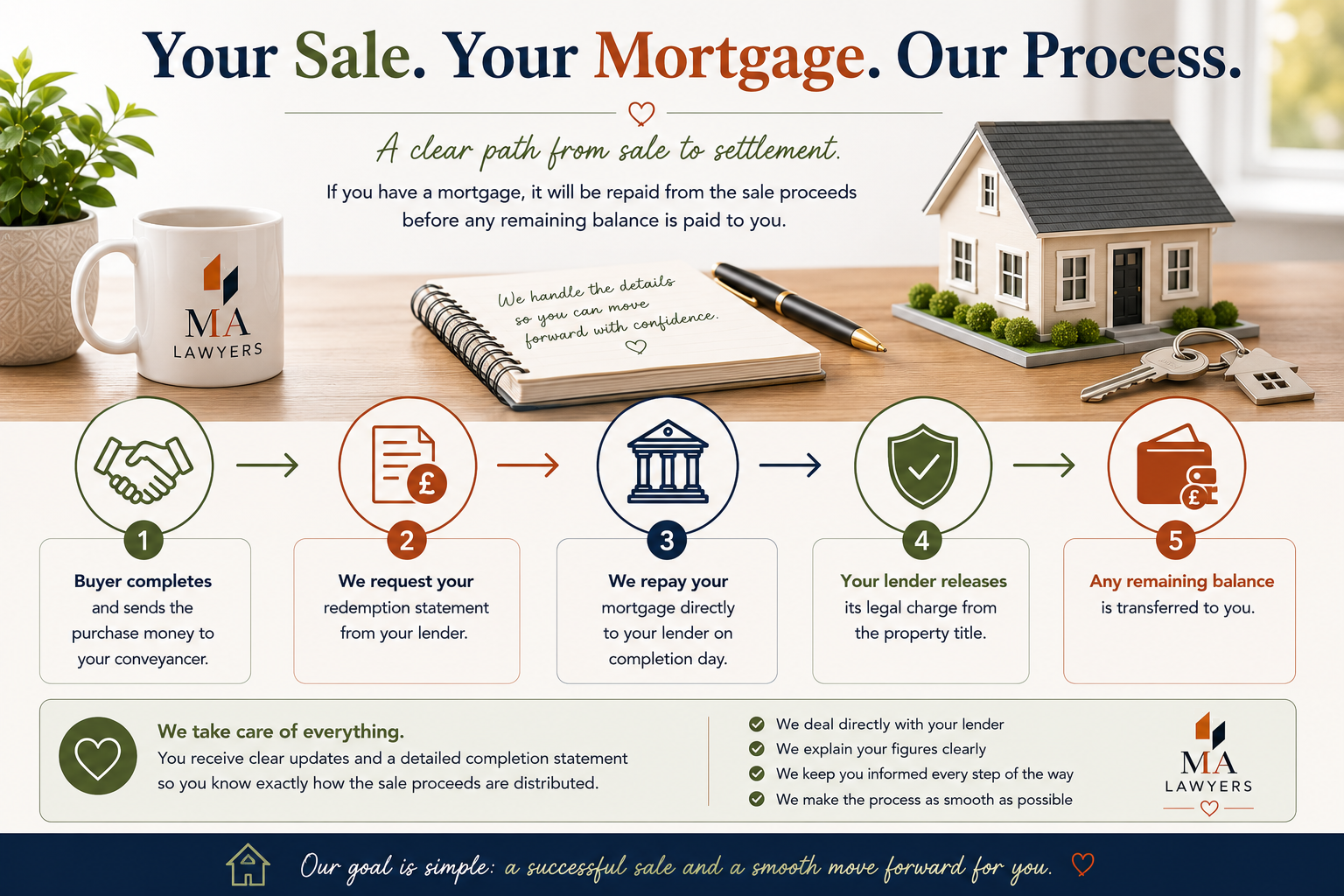
If you have a mortgage on your property, it will normally be repaid from the sale proceeds on the day of completion.
Before completion, your conveyancer will obtain a redemption statement from your lender confirming exactly how much is needed to repay your mortgage.
Once the sale has completed, your conveyancer will send the redemption money directly to your lender before transferring any remaining balance to you.
The Explanation
When you bought your property, your lender registered a legal charge against the title at HM Land Registry.
Before ownership can pass to the buyer, that legal charge must be removed.
Your conveyancer will therefore:
Contact your lender for an up-to-date redemption statement.
Check that the redemption figure will be covered by the sale proceeds.
Redeem your mortgage immediately following completion.
Ensure your lender releases its legal charge.
Transfer any remaining balance of the sale proceeds to you.
If you're buying another property at the same time, your sale proceeds can usually be used towards your onward purchase once your existing mortgage has been redeemed.
Common Questions
Will I need to contact my mortgage lender?
Usually not.
Your conveyancer will obtain the redemption statement and deal directly with your lender as part of the legal process.
What is a redemption statement?
A redemption statement confirms the exact amount required to repay your mortgage on a specific date.
It includes the outstanding balance together with any interest due up to the proposed completion date.
What if I'm buying another property?
If you're selling and buying on the same day, your sale proceeds are normally used towards your purchase after your existing mortgage has been redeemed.
Could I have to pay an early repayment charge?
Possibly.
Some mortgage products include an early repayment charge if the mortgage is repaid before a particular date.
Your redemption statement will confirm whether any such charge applies.
Top Tip
If you've recently changed your mortgage product or you're planning to port your mortgage to another property, let your conveyancer know as early as possible.
Did You Know?
Redemption figures are only valid for a limited period because mortgage interest usually continues to accrue daily until the mortgage is repaid.
Common Misconception
"The sale money comes straight to me."
Not quite.
Your conveyancer must first repay your mortgage and deal with any authorised deductions before transferring the remaining balance to you.
The MA Lawyers Approach
At MA Lawyers, we'll obtain your redemption statement, check the figures carefully and deal directly with your lender to ensure your mortgage is repaid correctly on completion.
We'll explain your completion statement in advance so you know exactly how the sale proceeds will be distributed, giving you a clear understanding of what you'll receive once your sale has completed.
Related Articles
When Will I Receive My Sale Proceeds?
Why Is My Sale Taking So Long?
Why Can't My Conveyancer Tell Me When We'll Complete?
We use cookies to improve your experience, understand website usage, and support marketing. You can accept all cookies, reject optional cookies, or manage your preferences.
California residents can opt out of the sale or sharing of personal information by rejecting marketing cookies.